
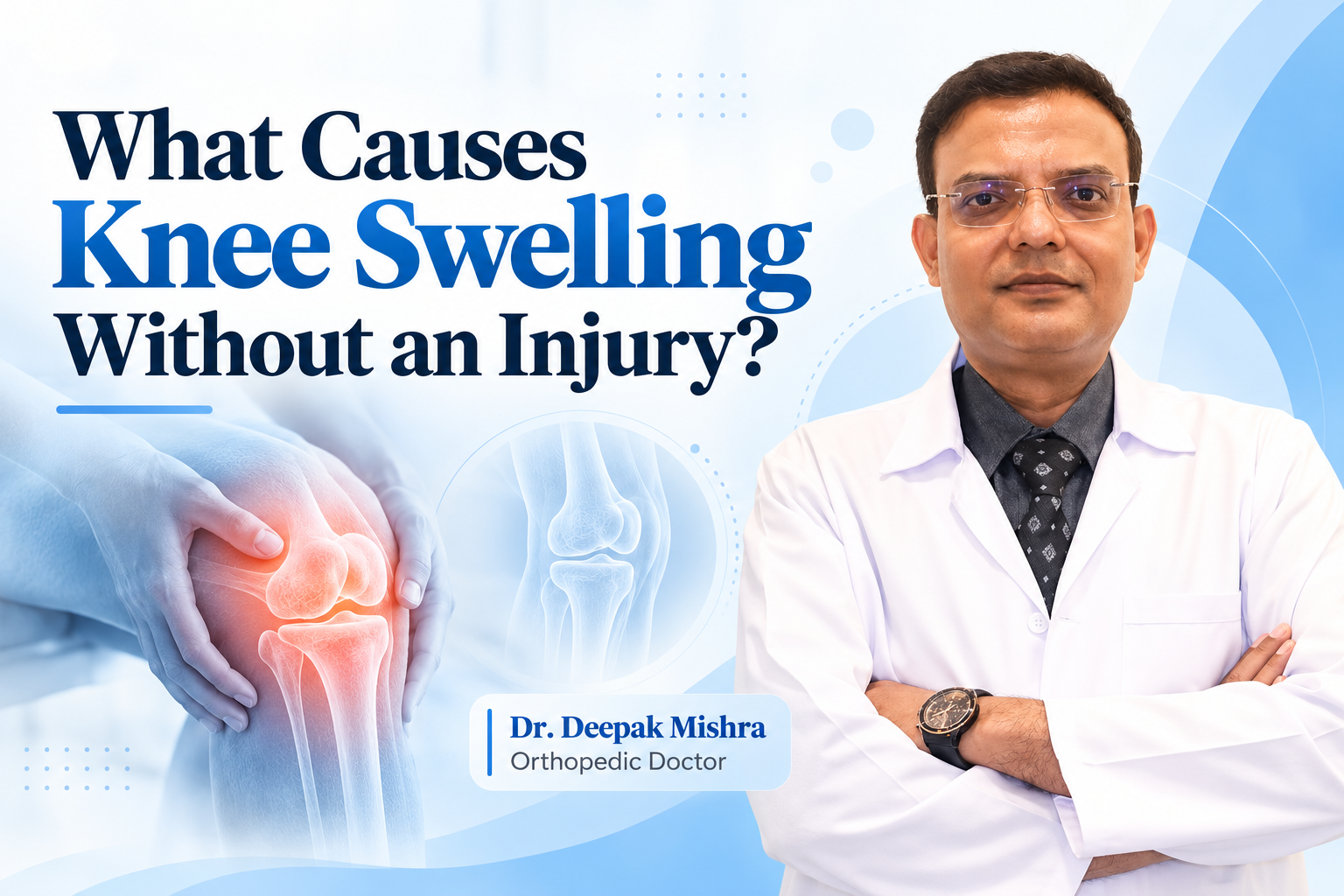
What Causes Knee Swelling Without an Injury
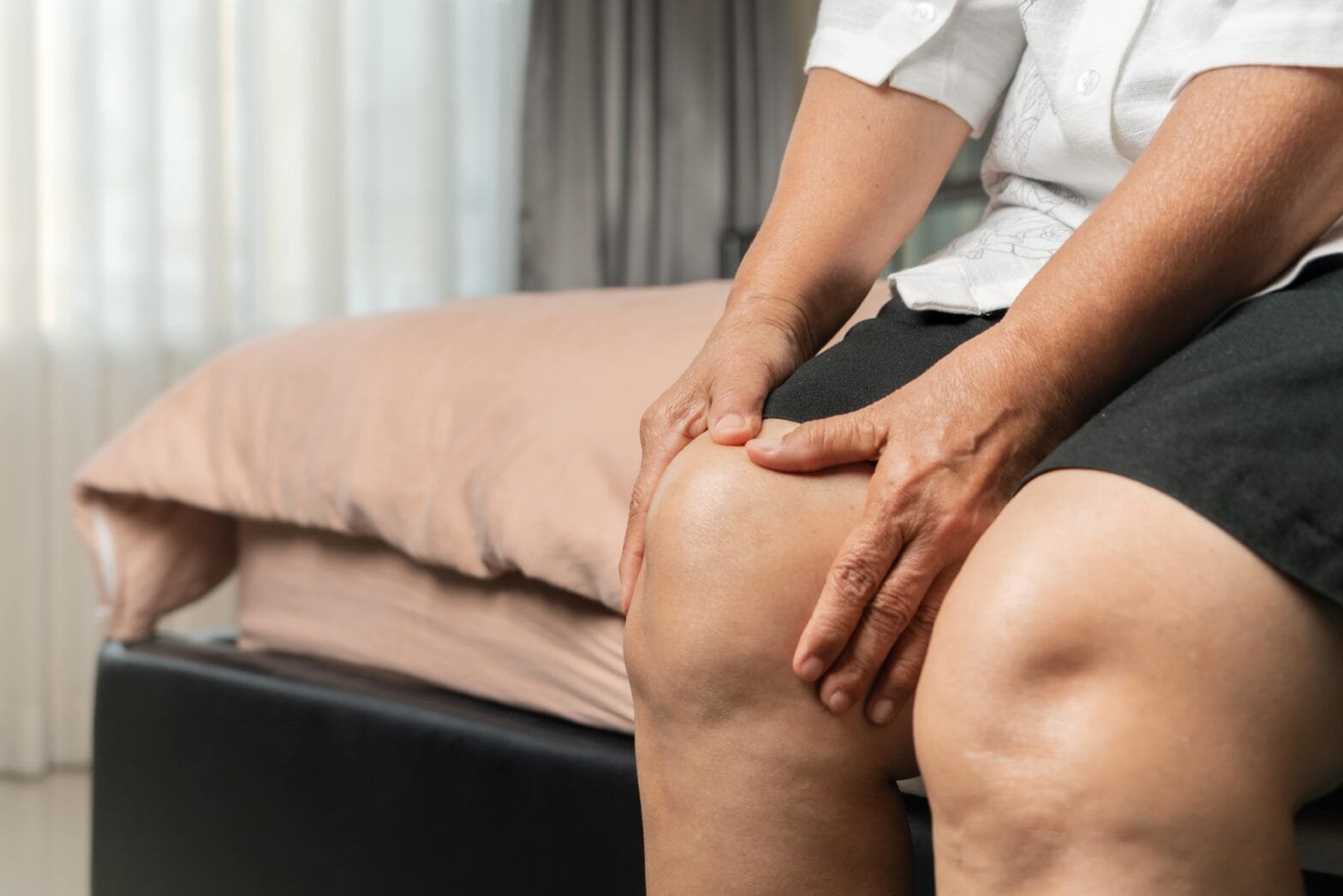
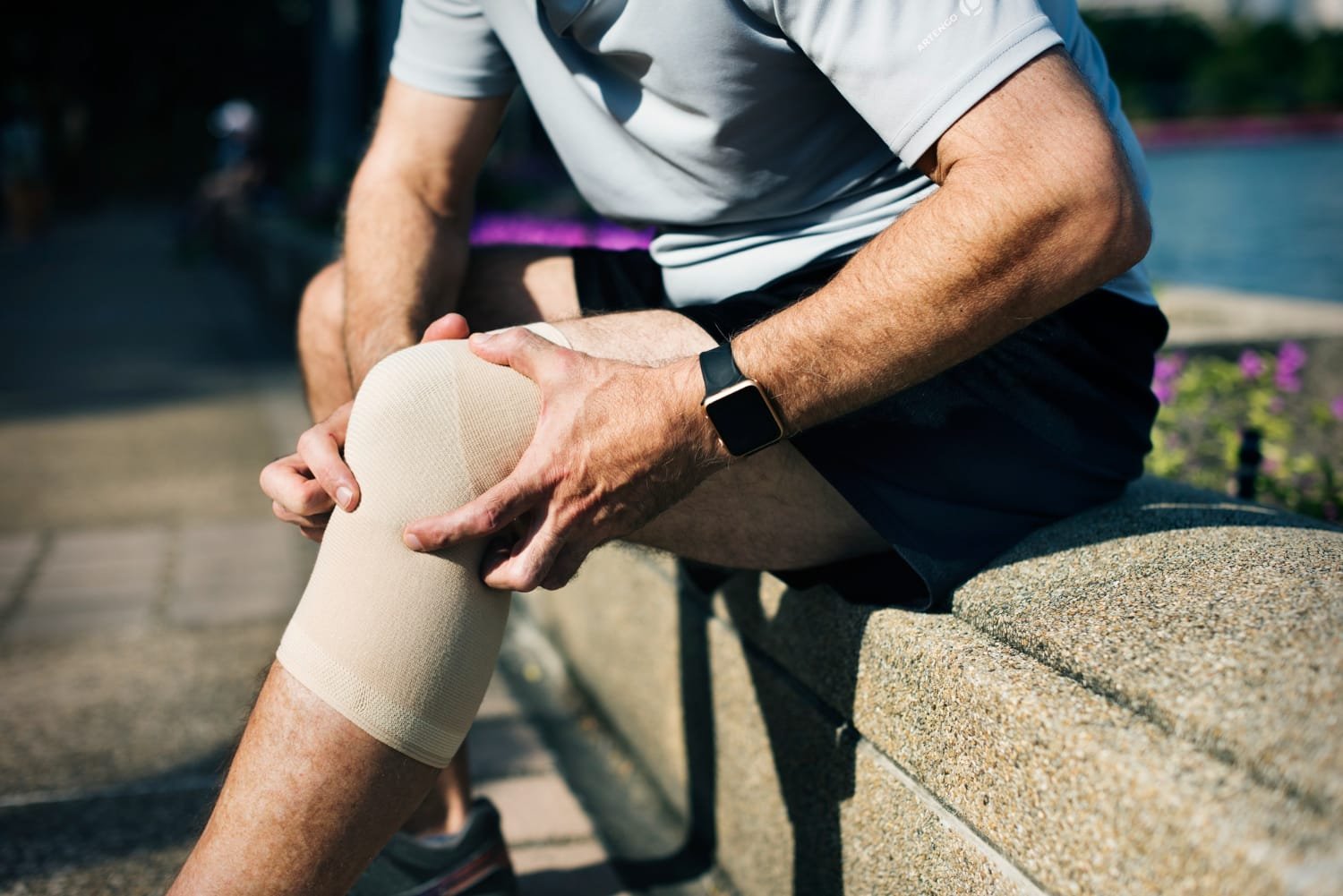
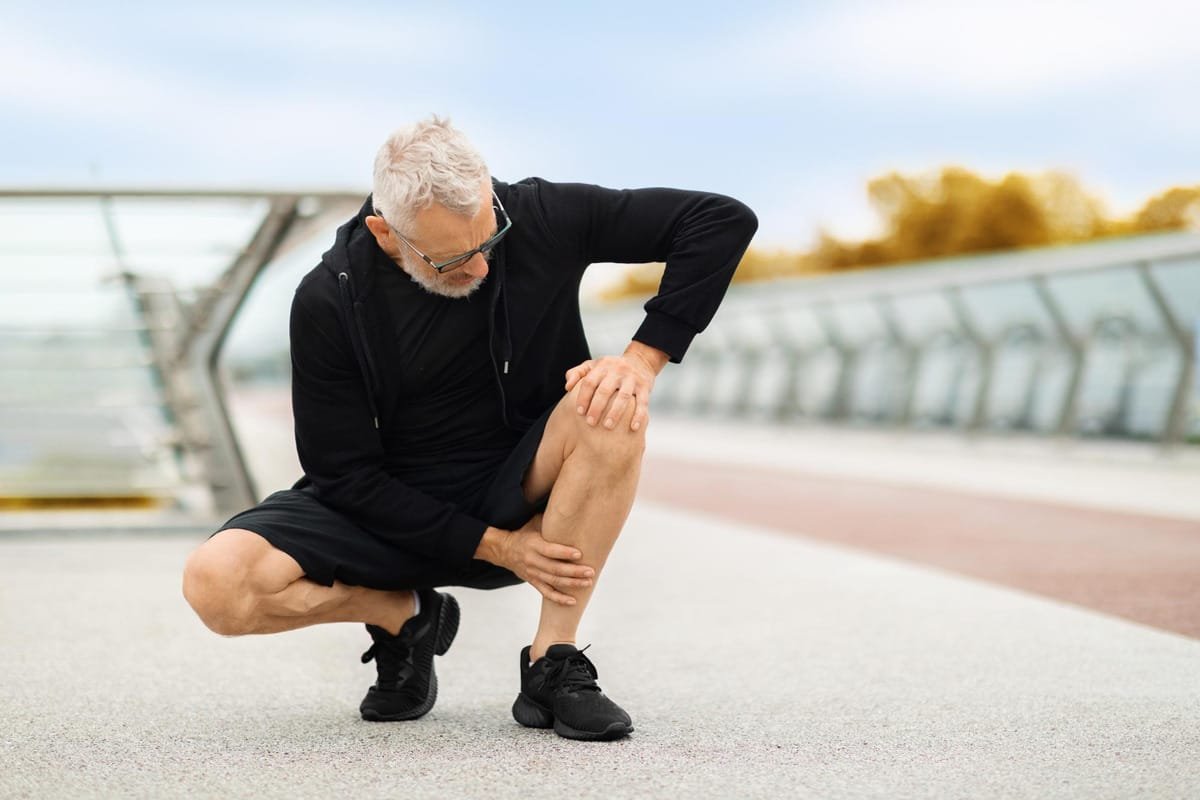
October 1, 2026Knee swelling can be worrying, especially when it appears without a fall, sports injury, accident or other obvious reason. You may wake up with a swollen knee, notice puffiness after a normal day of walking, or gradually feel increasing tightness around the joint even though you cannot remember injuring it.
While knee swelling after an injury is relatively easy to understand, knee swelling without an injury can have several possible causes. Arthritis, inflammation, infection, gout, bursitis and other joint conditions can all lead to fluid accumulation around or inside the knee.
In some people, the swelling may be mild and temporary. In others, it may be accompanied by Knee pain, stiffness, warmth, redness or difficulty walking. Understanding why your knee is swollen is therefore important because treatment depends on the underlying cause rather than the swelling alone.
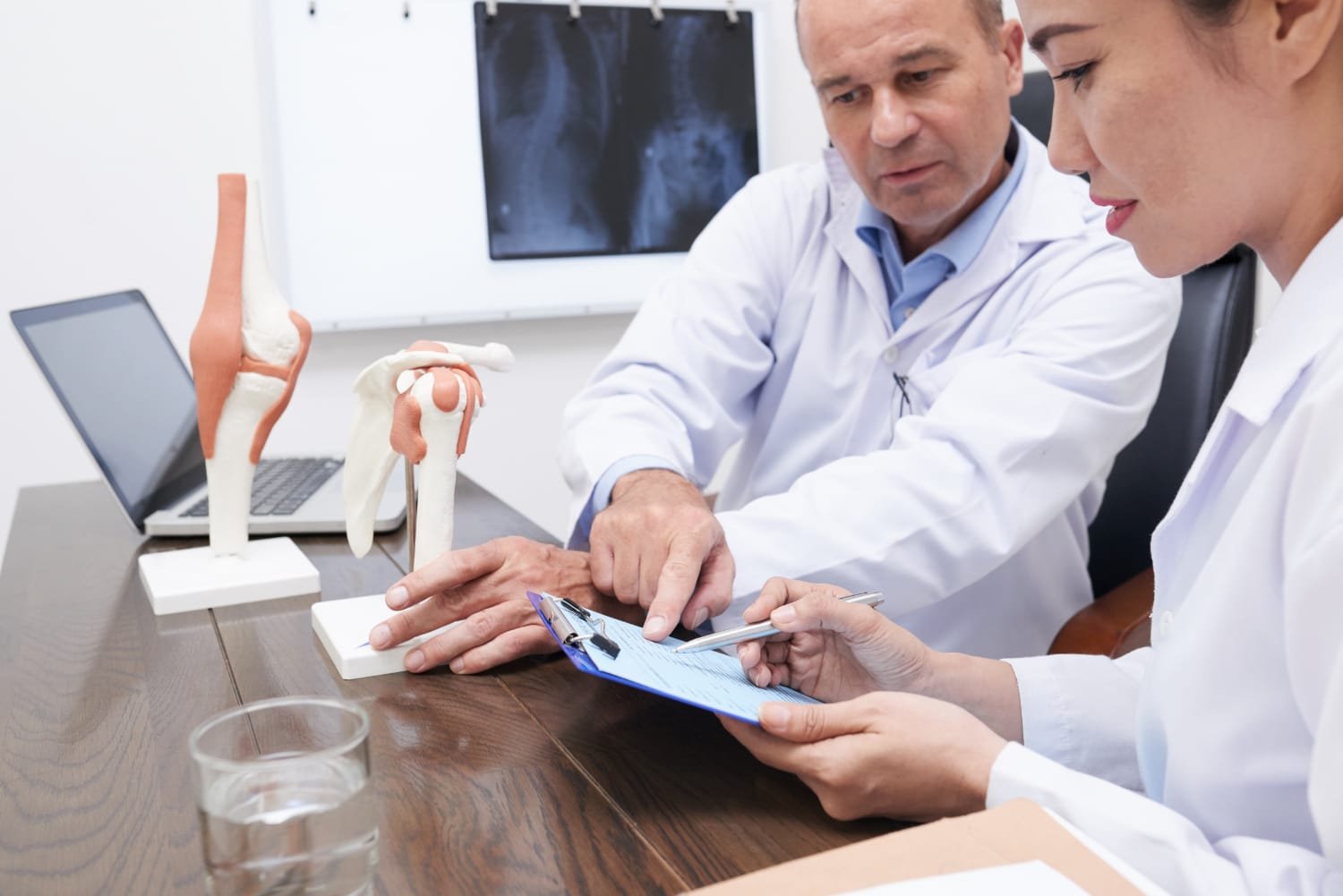
If knee swelling persists, repeatedly returns or affects your ability to walk comfortably, an evaluation by an orthopedic doctor can help identify the problem early.
What Does a Swollen Knee Mean?
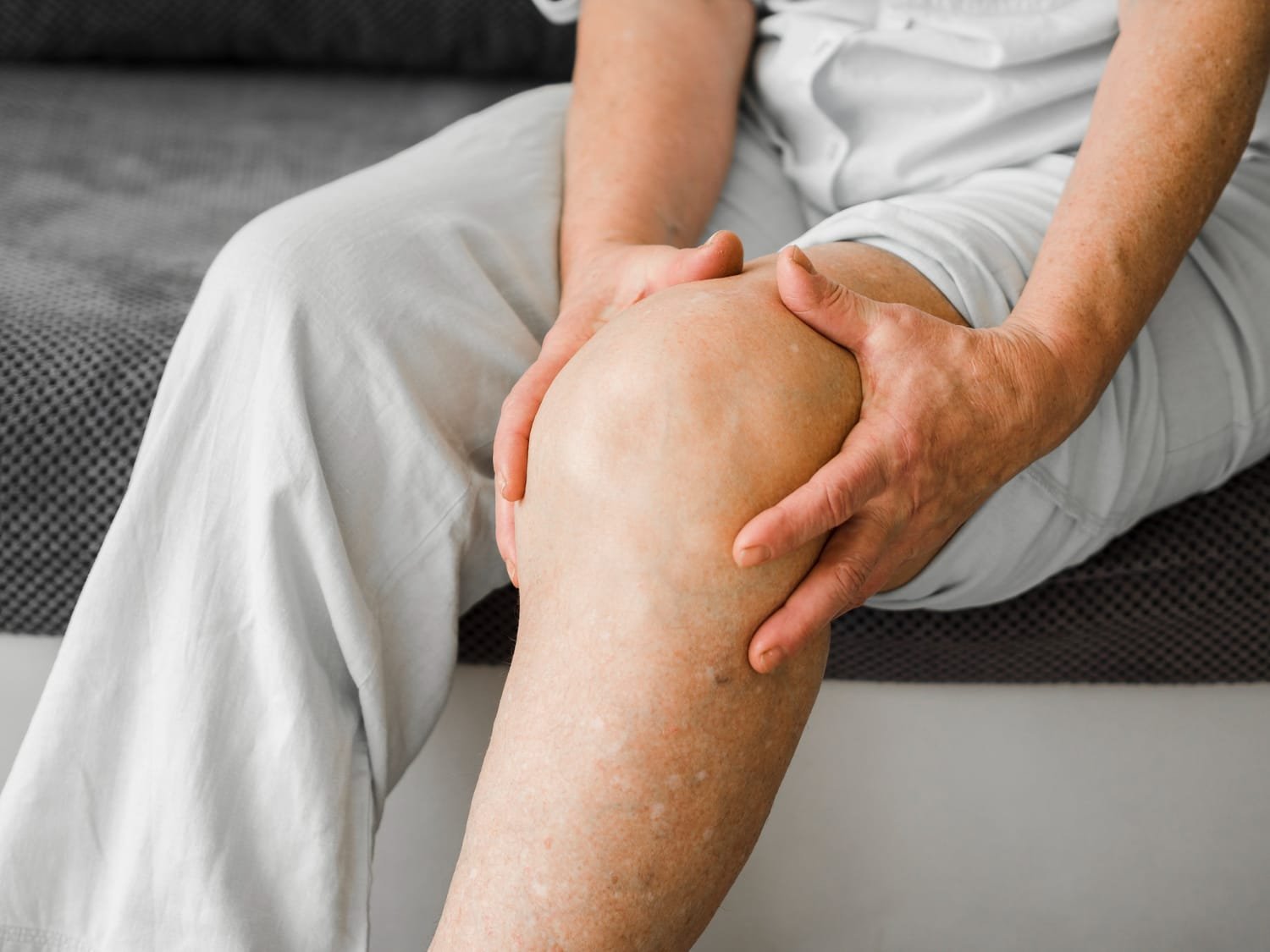
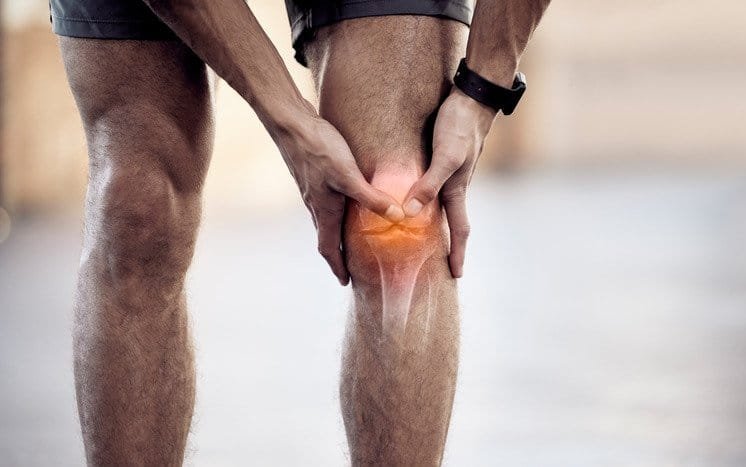
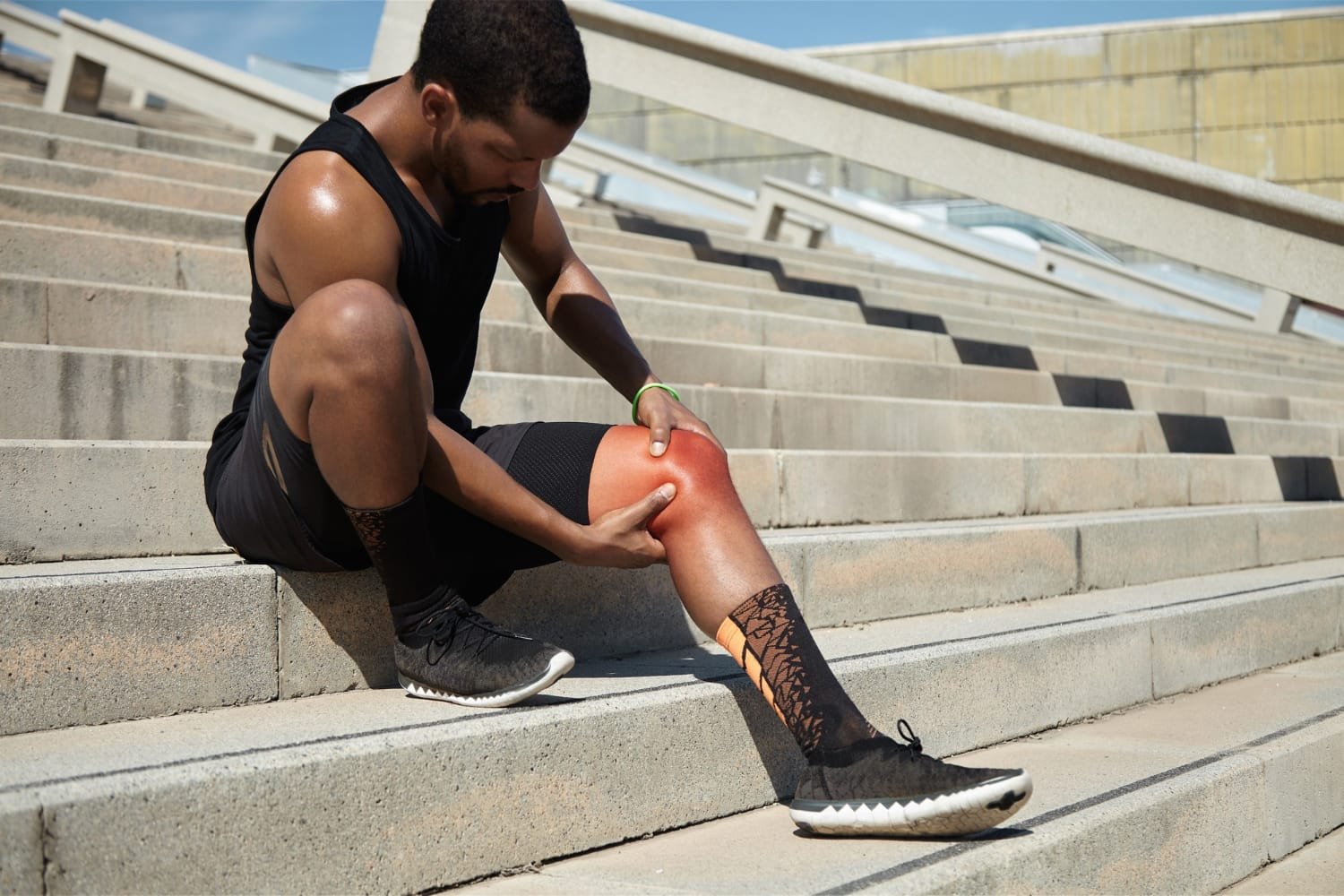
A swollen knee occurs when excess fluid builds up within the knee joint or in the tissues surrounding it.
Doctors sometimes refer to excess fluid inside the knee joint as a knee effusion. It is also commonly described as “water on the knee.”
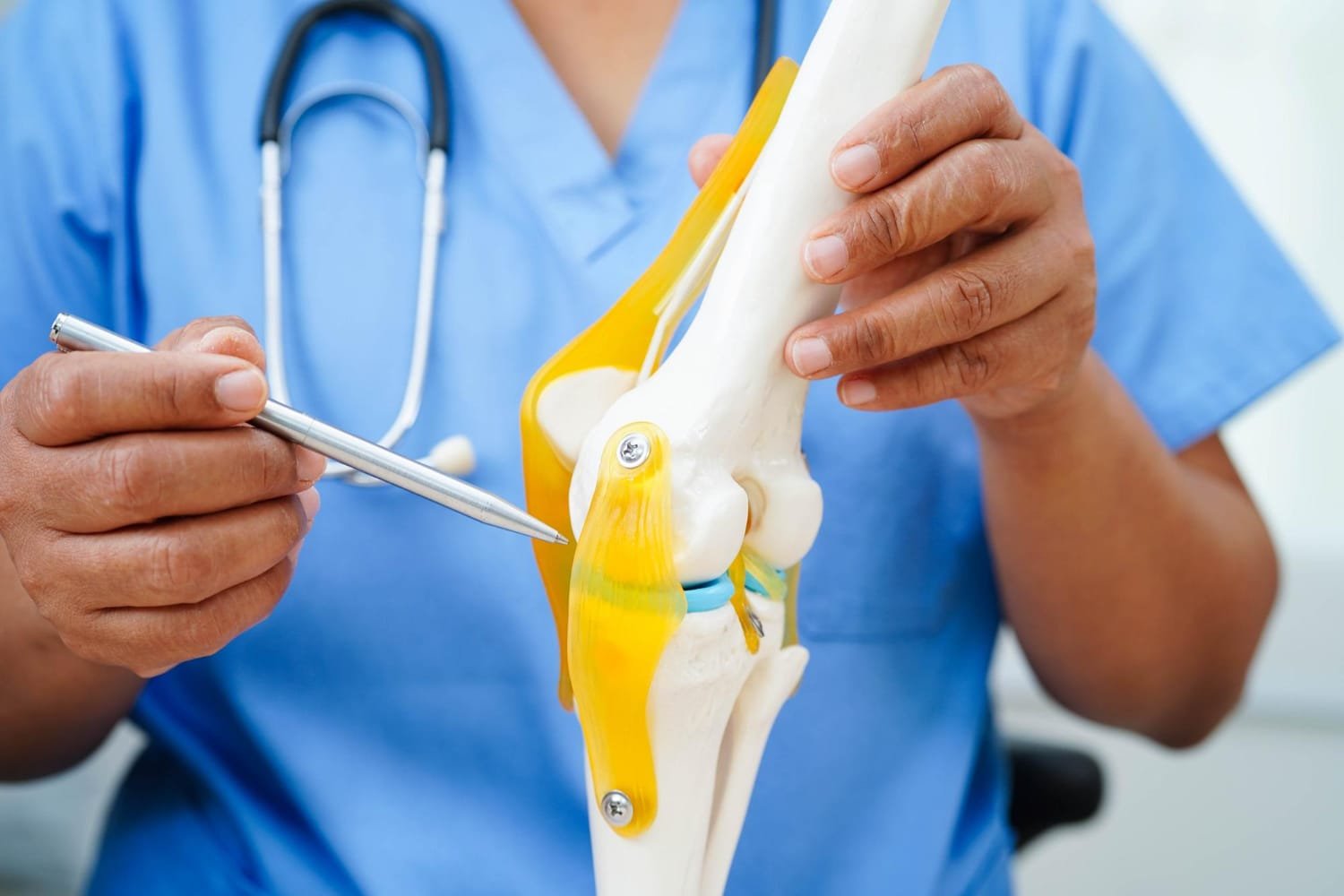
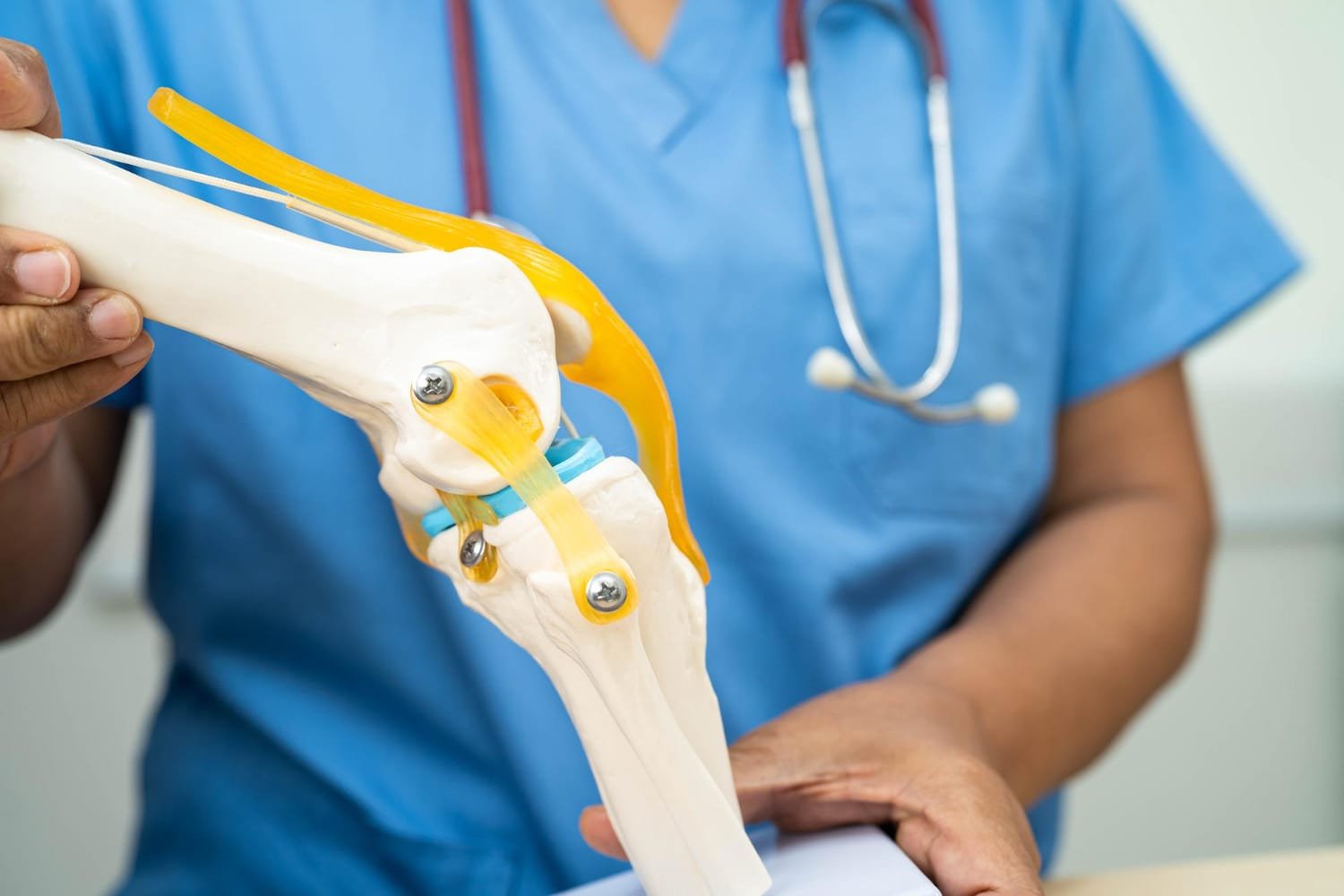
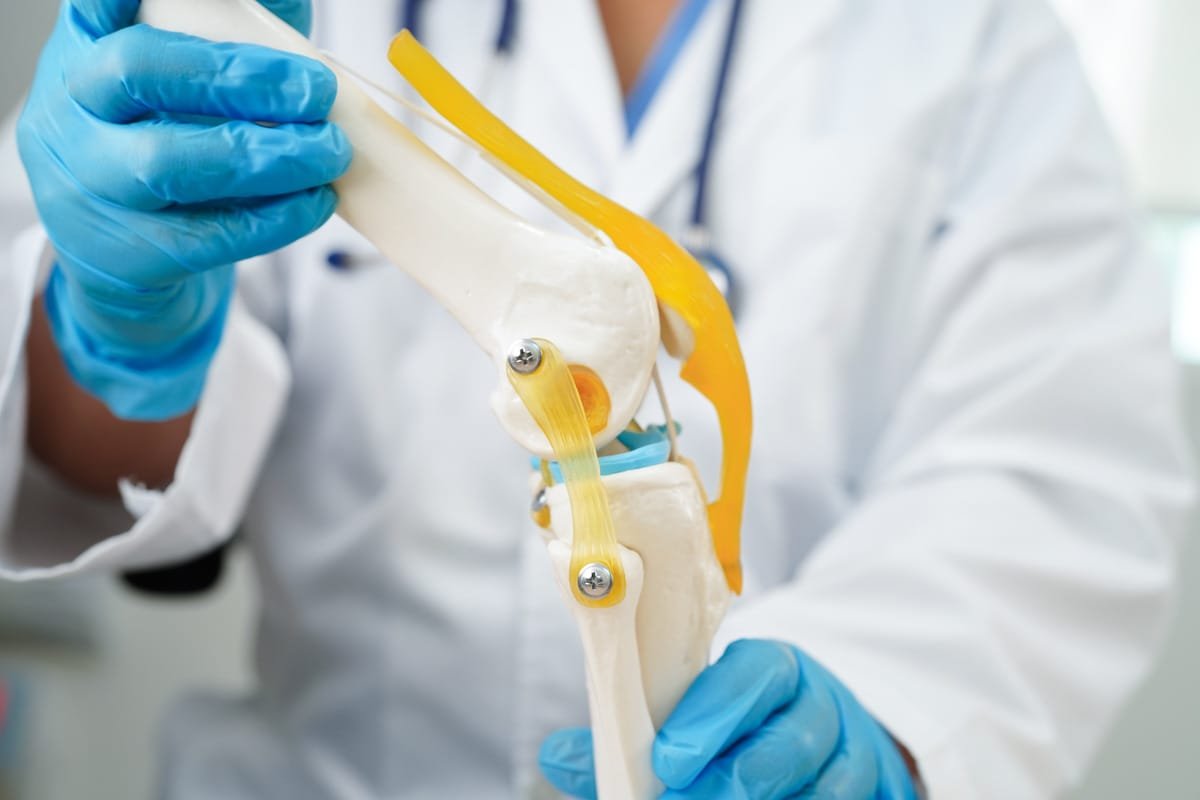
The knee is a complex joint made up of bones, cartilage, ligaments, tendons, muscles, bursae and joint fluid. When one of these structures becomes irritated or inflamed, the body may respond by producing additional fluid.
This can make the knee appear larger than the opposite knee and may cause:
- Tightness around the knee
- Reduced flexibility
- Pain while bending or straightening the leg
- Difficulty walking
- Heaviness in the joint
- Stiffness after sitting
- Warmth around the knee
A swollen knee does not automatically mean there is a serious problem, but persistent or unexplained swelling should not be ignored.
What Causes Knee Swelling Without an Injury?
Several medical conditions can cause swelling even when there has been no recent trauma.
Some of the most common causes include the following.
1. Osteoarthritis of the Knee
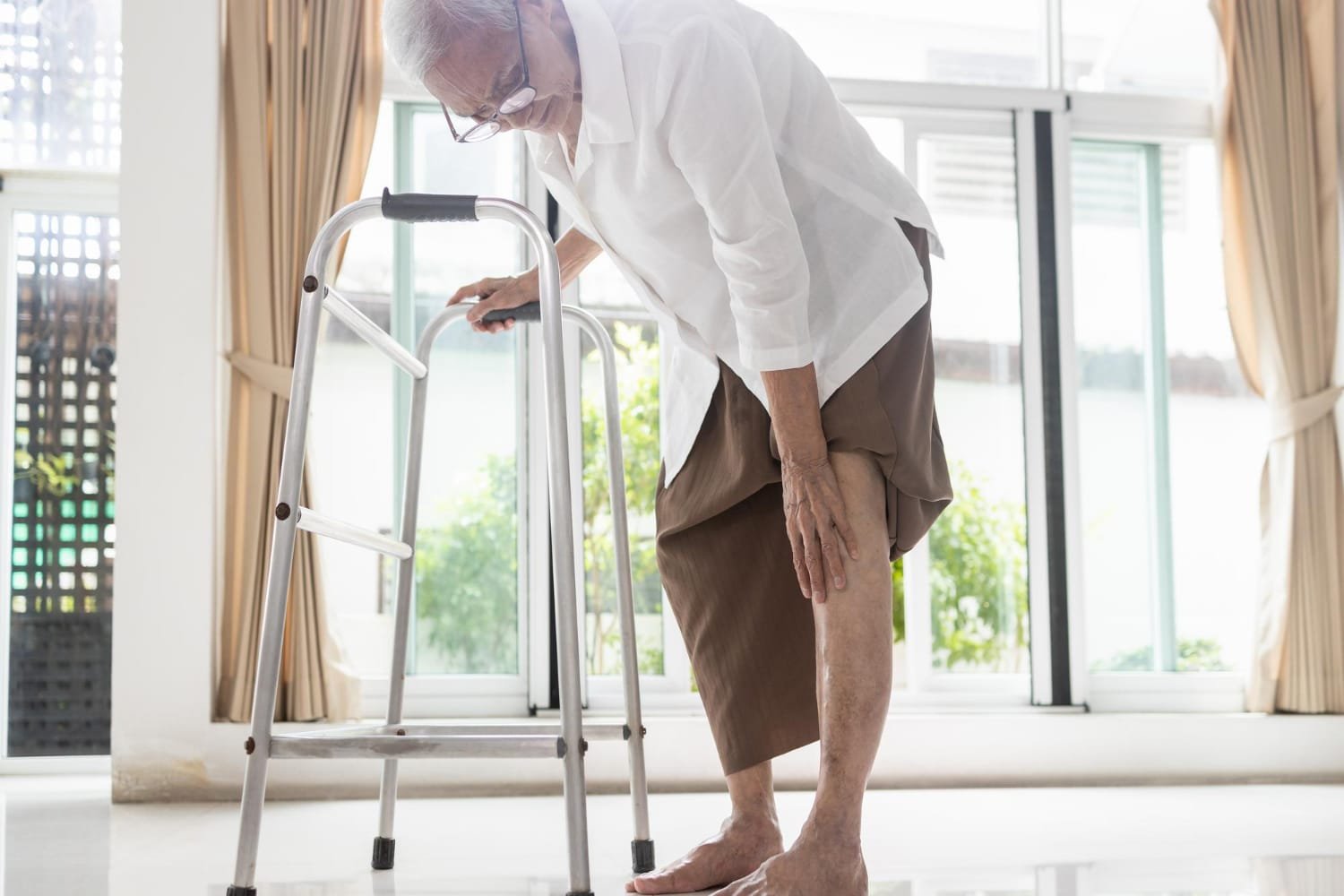
Osteoarthritis is one of the most common causes of knee pain and swelling, particularly among middle-aged and older adults.
The ends of the bones inside the knee are covered with cartilage that allows smooth movement. With osteoarthritis, this cartilage gradually becomes thinner and damaged.
The joint may become irritated and inflamed, resulting in increased fluid production.
Common symptoms of knee osteoarthritis include:
- Knee swelling
- Pain while walking
- Difficulty climbing stairs
- Stiffness after sitting for a long time
- Reduced knee movement
- Grinding or cracking sensations
- Pain while standing up from a chair
The swelling may come and go depending on physical activity and the severity of arthritis.
People with advanced osteoarthritis may experience persistent pain and increasingly limited mobility.
2. Rheumatoid Arthritis
Rheumatoid arthritis is an autoimmune condition in which the immune system mistakenly attacks the tissues lining the joints.
Unlike osteoarthritis, which is primarily associated with progressive joint degeneration, rheumatoid arthritis is an inflammatory disease.
It can affect several joints at the same time.
Possible symptoms include:
- Swollen knees
- Morning stiffness
- Warm joints
- Pain in multiple joints
- Fatigue
- Reduced mobility
If swelling occurs in both knees or is associated with swelling in the hands, wrists, feet or other joints, further evaluation may be necessary.
3. Gout
Gout is another possible cause of sudden knee swelling without an injury.
It occurs when uric acid crystals accumulate inside a joint and trigger intense inflammation.
Although gout frequently affects the big toe, it can also involve the knee.
A gout attack may cause:
- Sudden severe knee pain
- Significant swelling
- Warmth
- Redness
- Tenderness
- Difficulty moving the knee
Symptoms may develop quickly, sometimes overnight.
People with recurrent gout should seek appropriate medical management because repeated attacks may eventually damage affected joints.
4. Pseudogout
Pseudogout can produce symptoms similar to gout but is caused by a different type of crystal accumulating inside the joint.
The medical term for the condition is calcium pyrophosphate deposition disease.
The knee is one of the joints commonly affected.
Symptoms may include sudden swelling, pain, warmth and reduced movement.
Because gout, pseudogout and joint infections can sometimes produce similar symptoms, proper diagnosis is important.
5. Knee Bursitis
Around the knee are small fluid-filled sacs called bursae. These structures reduce friction between tendons, muscles, skin and bones.
When one of these bursae becomes irritated or inflamed, the condition is called bursitis.
One common type is prepatellar bursitis, which affects the area in front of the kneecap.
Bursitis may develop without a single significant injury. Repeated kneeling, pressure or minor irritation can gradually trigger inflammation.
People whose occupations or daily activities require prolonged kneeling may be more susceptible.
Symptoms may include:
- Swelling around the kneecap
- Tenderness
- Warmth
- Discomfort while kneeling
- Tightness when bending the knee
6. Overuse of the Knee
Not every knee problem requires a major injury.
Sometimes the knee becomes irritated because activity levels have suddenly increased.
For example, swelling may develop after:
- Walking considerably more than usual
- Starting a new exercise routine
- Running long distances
- Frequent stair climbing
- Repeated squatting
- Standing for prolonged periods
A person may therefore say, “I did not injure my knee,” even though repetitive stress has irritated the joint.
Overuse-related swelling often improves with appropriate rest and activity modification, but persistent symptoms should be evaluated.
7. Meniscus Problems
The menisci are cartilage structures inside the knee that help distribute pressure and stabilize the joint.
Meniscus tears are often associated with twisting injuries, particularly in younger people. However, degenerative meniscus tears can develop gradually with age.
This means that someone may develop knee swelling without remembering any particular injury.
Possible symptoms include:
- Swelling
- Pain along the joint line
- Clicking or catching
- Difficulty squatting
- Pain while turning
- Knee locking in some cases
An orthopedic evaluation can help determine whether symptoms are coming from the meniscus or another knee structure.
8. Baker’s Cyst
A Baker’s cyst is a fluid-filled swelling that forms behind the knee.
It often develops when another condition, such as arthritis, causes the knee to produce excess joint fluid.
The fluid can collect toward the back of the knee and create a noticeable lump or feeling of pressure.
Symptoms may include:
- Swelling behind the knee
- Tightness
- Difficulty bending the knee
- Discomfort after prolonged standing
- A feeling of fullness behind the joint
Treating the condition responsible for excess fluid is often an important part of managing a Baker’s cyst.
9. Infection Inside the Knee Joint
Although less common than arthritis or overuse, an infection inside the joint can cause knee swelling and requires prompt medical attention.
This condition is sometimes called septic arthritis.
Symptoms may include:
- Rapidly increasing swelling
- Significant pain
- Warmth
- Redness
- Fever
- Difficulty putting weight on the leg
- Feeling generally unwell
A painful, hot, swollen knee associated with fever should not simply be treated at home.
Immediate medical evaluation is important because joint infections can damage cartilage and other tissues if treatment is delayed.
10. Inflammatory Joint Conditions
Other inflammatory diseases can occasionally cause swelling around the knee.
These may include certain autoimmune or rheumatological conditions.
The swelling may occur together with:
- Pain in several joints
- Prolonged morning stiffness
- Back stiffness
- Skin changes
- Eye inflammation
- General fatigue
Your orthopedic doctor may recommend additional testing or referral to another specialist when an inflammatory condition is suspected.
11. Excessive Body Weight
Excess body weight does not usually cause sudden knee swelling by itself, but it can increase mechanical stress across the knee joint.
Over time, this additional load can contribute to cartilage degeneration and aggravate osteoarthritis.
For people already experiencing knee arthritis, higher body weight may contribute to:
- Increased pain
- Swelling after activity
- Reduced walking tolerance
- Faster progression of symptoms
Weight management, appropriate exercises and muscle strengthening may therefore form part of long-term knee care.
12. Age-Related Degenerative Changes
As people get older, cartilage, meniscus tissue and other structures within the knee naturally undergo changes.
Some degenerative changes cause no symptoms, whereas others can trigger inflammation, stiffness or swelling.
A person may therefore experience swelling without a recent accident or sports injury.
Age alone, however, should never be assumed to be the explanation. A proper diagnosis helps determine exactly what is happening inside the knee.
Is Knee Swelling Without Pain Serious?
Not necessarily.
Some people notice visible swelling without significant pain. This may occur with mild joint effusion, a Baker’s cyst, bursitis or early degenerative changes.
However, painless swelling that repeatedly returns should still be assessed.
Swelling is a sign that something is affecting the tissues around or inside the knee.
Identifying the underlying problem allows treatment to begin before mobility becomes significantly affected.
When Should You See an Orthopedic Doctor for Knee Swelling?
Consider consulting an orthopedic specialist when:
- Swelling lasts for several days
- Swelling keeps returning
- The knee becomes increasingly painful
- You cannot fully bend or straighten the knee
- Walking becomes difficult
- The knee feels unstable
- The knee frequently locks or catches
- Swelling occurs along with significant stiffness
- Symptoms are interfering with sleep or normal activities
Seek Prompt Medical Attention If:
Knee swelling is accompanied by:
- Fever
- Marked redness
- Significant warmth
- Severe pain
- Rapidly increasing swelling
- Inability to bear weight
- Feeling unwell
These symptoms may require urgent medical evaluation.
How Is the Cause of Knee Swelling Diagnosed?
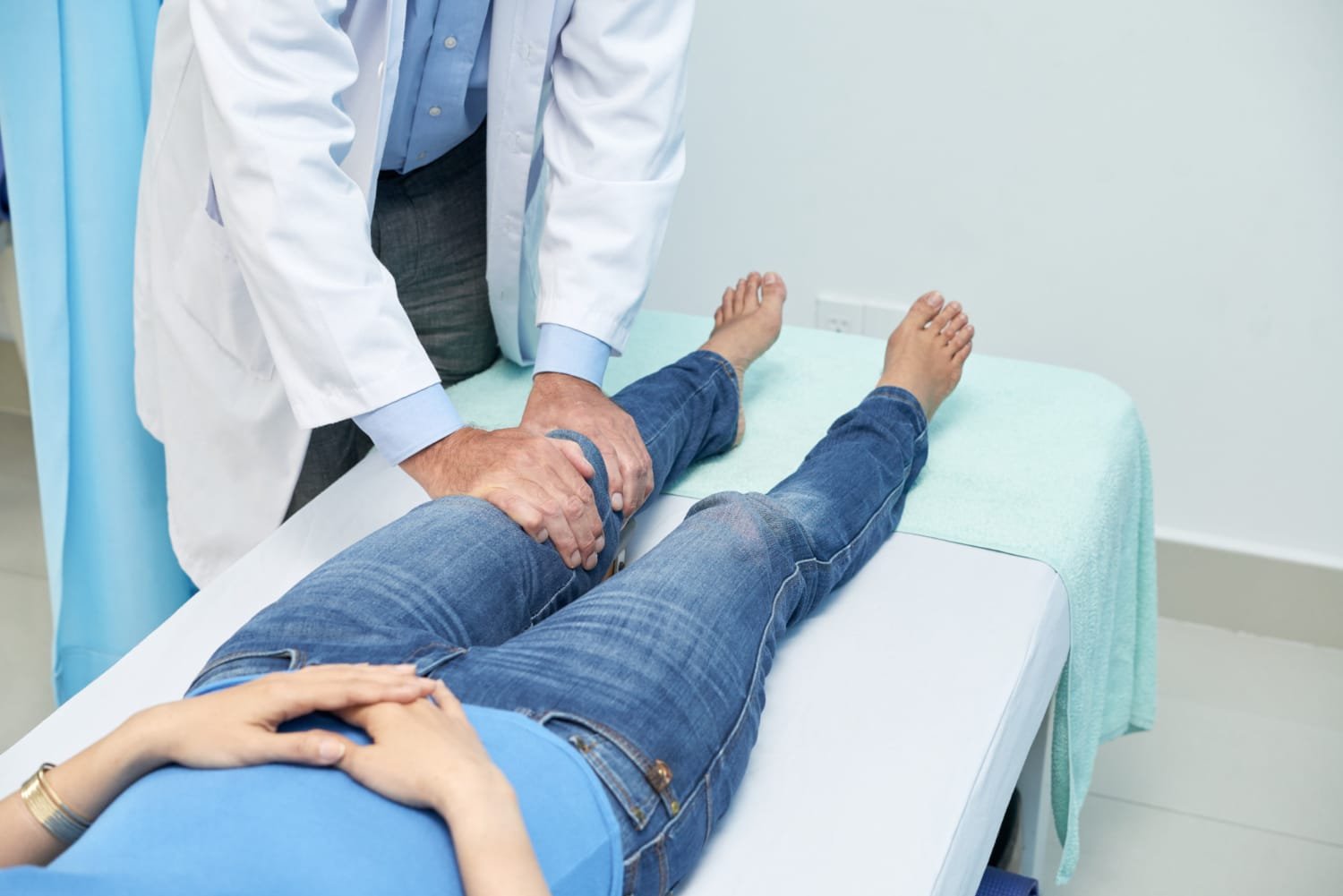
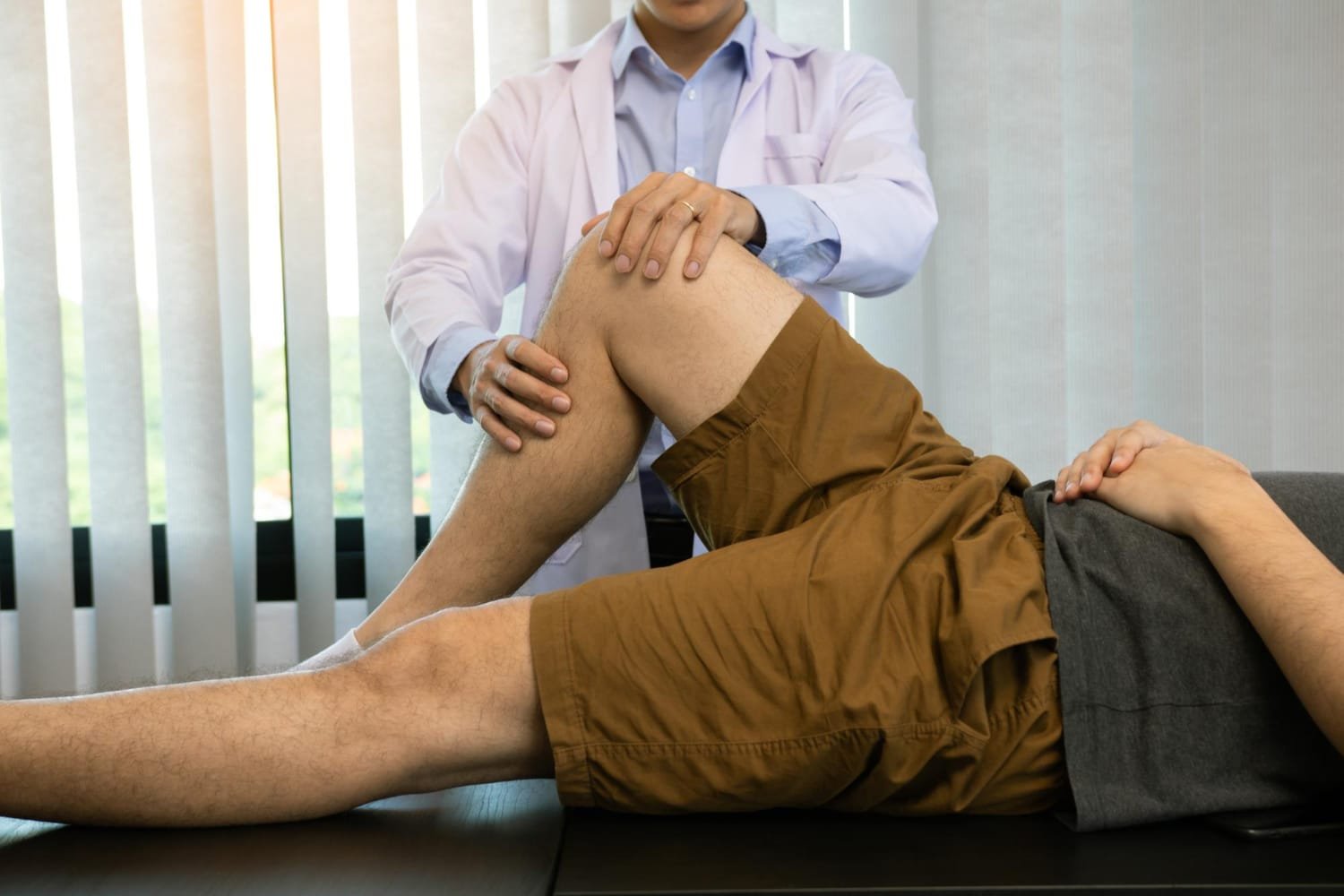
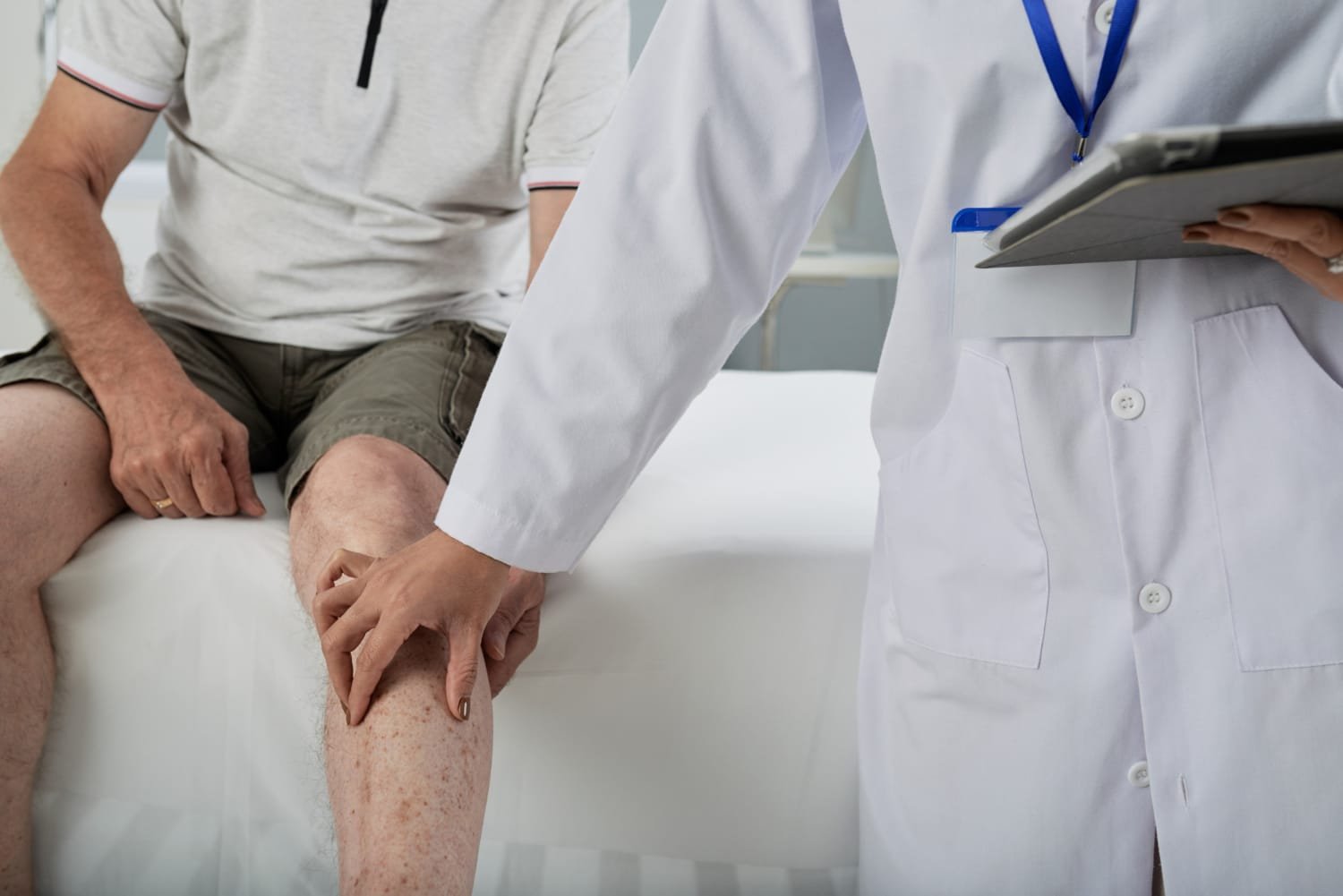
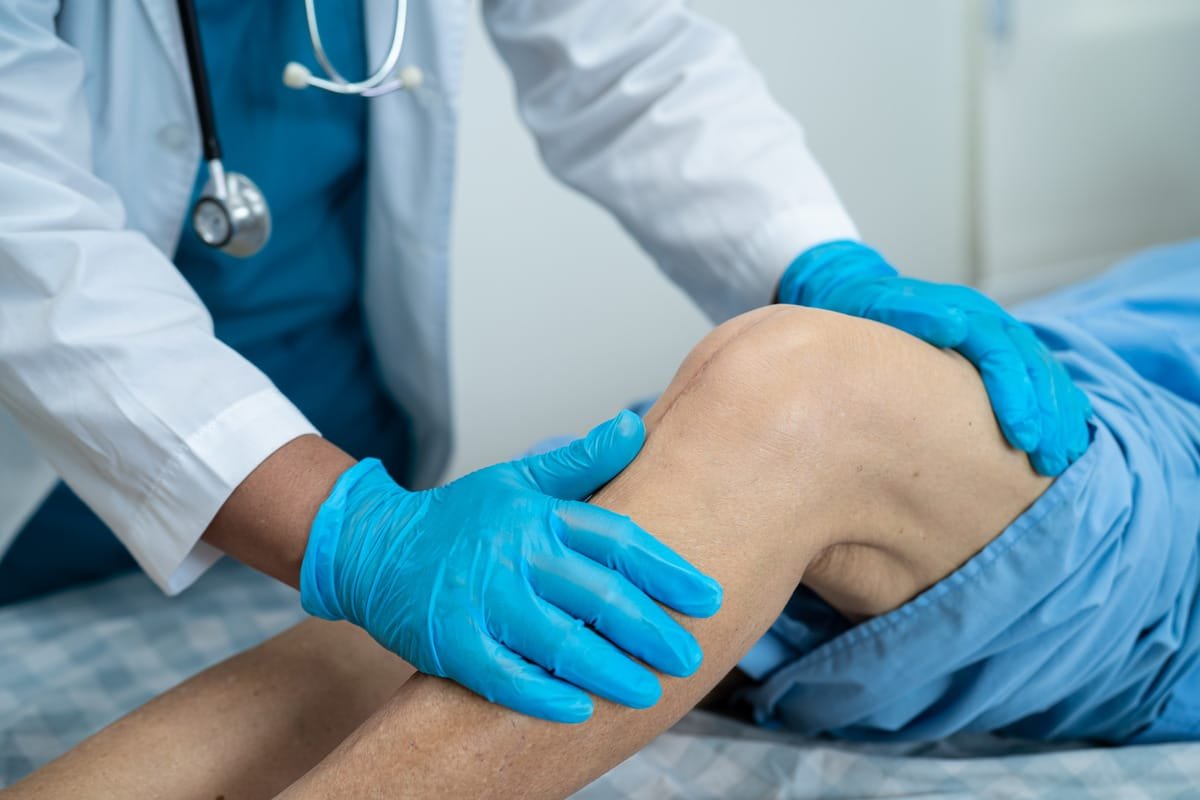
The first step is usually a detailed medical history and physical examination.
The orthopedic doctor may ask:
- When did the swelling begin?
- Did it develop suddenly or gradually?
- Is there pain?
- Have you experienced previous knee problems?
- Does swelling increase after activity?
- Do you have morning stiffness?
- Do you have arthritis, gout or another medical condition?
- Does the knee lock or give way?
The doctor may then assess:
- Location of swelling
- Knee movement
- Tenderness
- Joint stability
- Alignment
- Warmth
- Muscle strength
- Walking pattern
Depending on the suspected cause, investigations may be recommended.
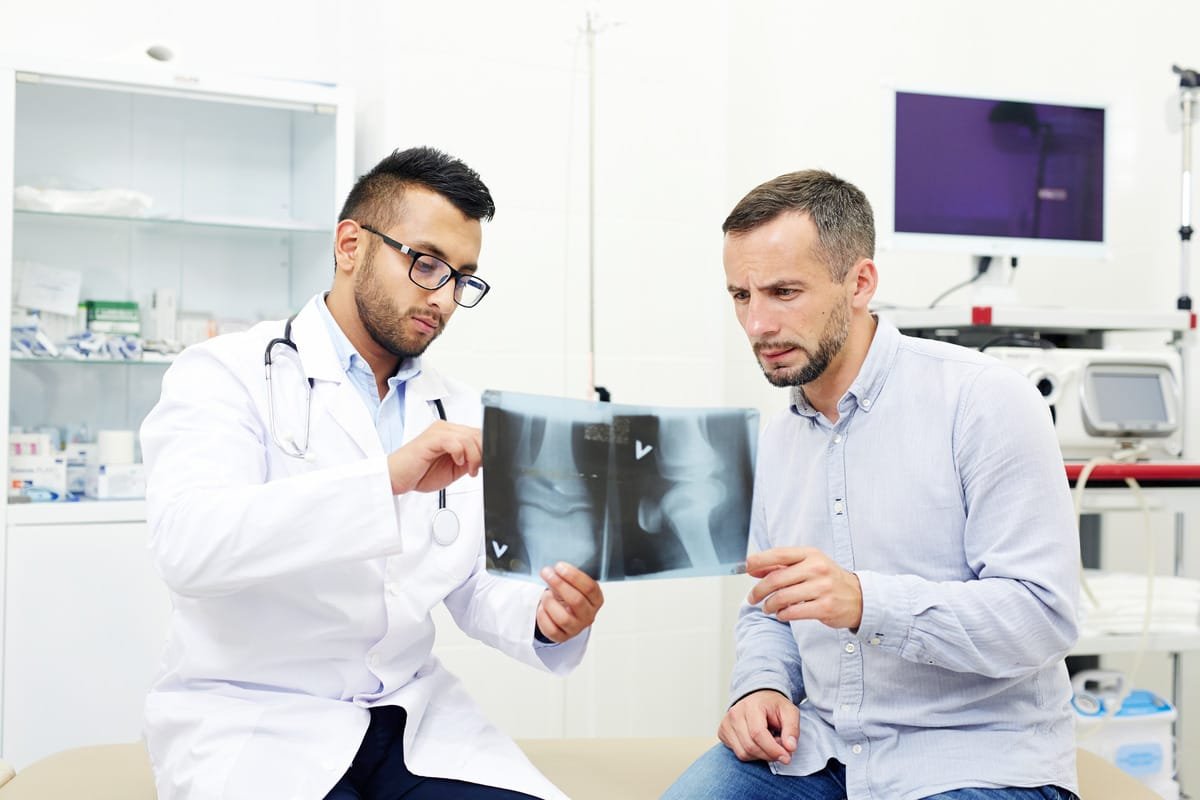
X-Ray
An X-ray can help identify changes associated with osteoarthritis, narrowing of the joint space, bone spurs and certain bone abnormalities.
Weight-bearing X-rays can be particularly useful when assessing knee arthritis.
MRI Scan
An MRI provides detailed images of the soft tissues inside the knee.
It may be recommended in selected patients when the doctor suspects problems involving structures such as:
- Meniscus
- Ligaments
- Cartilage
- Tendons
Not every swollen knee requires an MRI.
Blood Tests
Blood tests may be advised when gout, inflammatory arthritis or infection is suspected.
Joint Fluid Analysis
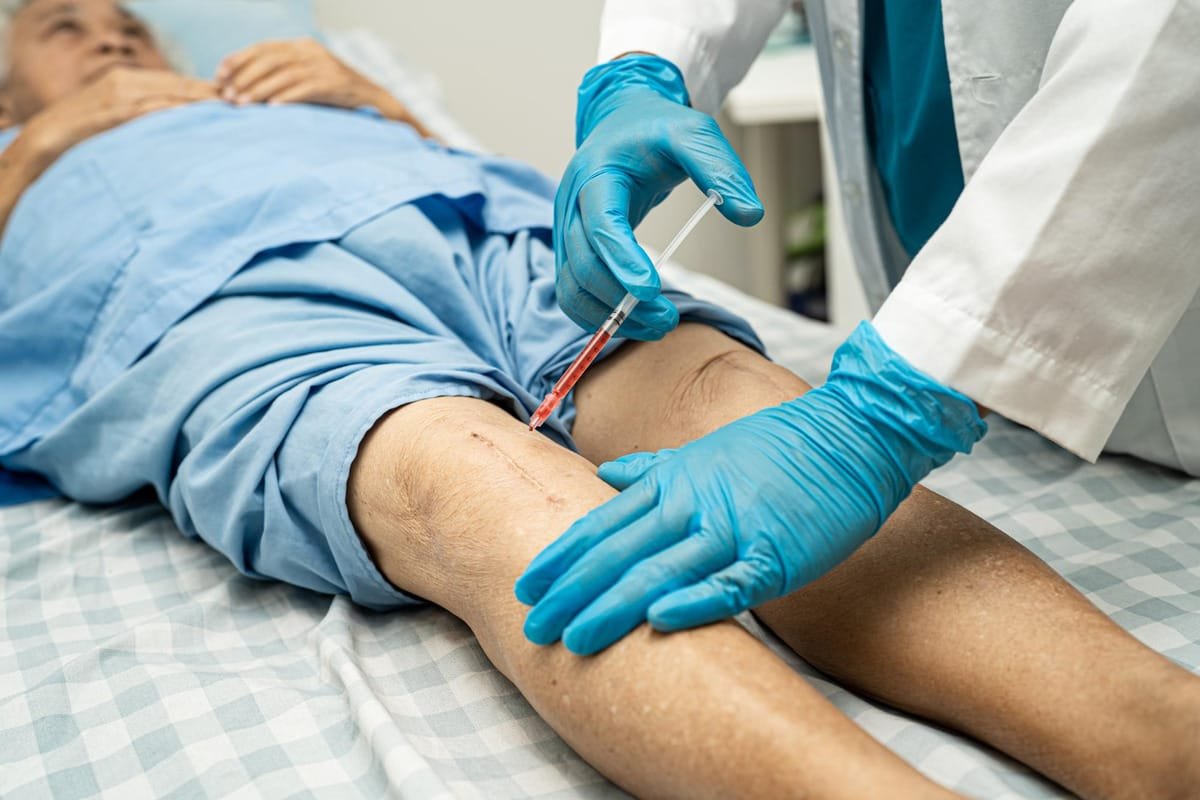
In certain cases, the doctor may remove a small amount of fluid from the knee using a sterile needle.
The fluid can then be examined to look for:
- Infection
- Uric acid crystals
- Other crystals
- Signs of inflammation
This can be particularly helpful when the cause of sudden swelling is unclear.
Treatment for Knee Swelling Without Injury
Treatment depends on the diagnosis.
There is no single treatment that is appropriate for every swollen knee.
Rest and Activity Modification
Temporarily reducing activities that aggravate the knee may help settle mild inflammation.
High-impact activities, repeated squatting or prolonged standing may need to be restricted for a short period depending on the condition.
Cold Therapy
Applying a wrapped cold pack for short periods may help reduce swelling and discomfort in some situations.
Ice should not be placed directly on the skin.
Elevation
Keeping the leg elevated may help reduce mild swelling, particularly after prolonged activity.
Medication
Pain-relieving or anti-inflammatory medications may be recommended depending on the patient’s health history and diagnosis.
People should avoid repeatedly taking medication without medical guidance, particularly when swelling continues to return.
Physiotherapy
Physiotherapy can be useful for many knee conditions.
A structured program may focus on improving:
- Quadriceps strength
- Hamstring strength
- Knee flexibility
- Balance
- Walking mechanics
- Overall lower-limb function
Stronger muscles around the knee can reduce stress on the joint and support better movement.
Treatment for Arthritis
Early and moderate knee arthritis may often be managed using a combination of:
- Activity modification
- Weight management
- Medication
- Physiotherapy
- Muscle strengthening
- Other non-operative treatments when appropriate
Surgery is not automatically recommended simply because arthritis is present.
Knee Replacement Surgery
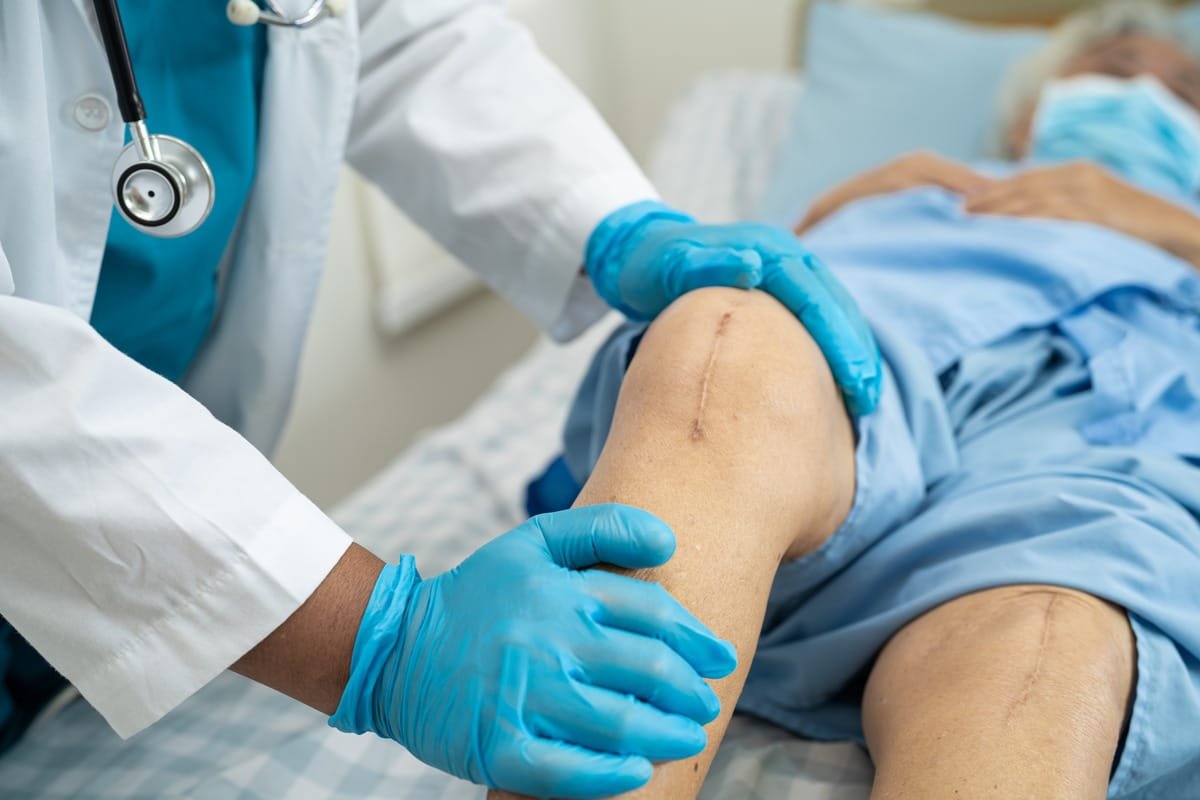
For advanced knee arthritis causing persistent pain, severe stiffness and major difficulty with everyday activities, knee replacement may eventually be considered.
The decision depends on factors such as:
- Degree of joint damage
- Severity of symptoms
- Response to previous treatment
- Patient’s mobility
- Overall health
- Effect on quality of life
Some patients may require total knee replacement, while carefully selected patients with arthritis limited to one compartment may be considered for partial knee replacement.
Can Knee Swelling Go Away on Its Own?
Mild swelling caused by temporary overuse may improve after reducing the activities that triggered it.
However, swelling caused by conditions such as arthritis, gout, bursitis, meniscus degeneration or inflammatory disease may return unless the underlying condition is treated.
Instead of repeatedly treating only the visible swelling, it is more useful to determine why the fluid is accumulating.
Can You Walk With a Swollen Knee?
That depends on the cause and severity.
If swelling is mild and walking does not significantly increase pain, gentle movement may be possible.
However, forcing yourself to continue strenuous activity through significant swelling or pain may aggravate certain conditions.
Stop the activity and seek medical advice if you experience:
- Severe pain
- Knee instability
- Locking
- Rapid swelling
- Significant warmth
- Difficulty bearing weight
How Can You Prevent Recurrent Knee Swelling?
Not every episode can be prevented, but certain measures may reduce unnecessary stress on the knees.
These include:
- Maintaining a healthy body weight
- Strengthening the muscles around the knee
- Increasing exercise intensity gradually
- Wearing appropriate footwear
- Avoiding sudden increases in running or walking distance
- Warming up before exercise
- Managing arthritis appropriately
- Avoiding prolonged repetitive kneeling when possible
- Seeking treatment for recurring knee symptoms rather than ignoring them
Regular physical activity is generally beneficial for joint health, but the type and intensity of exercise should suit your age, fitness level and existing knee condition.
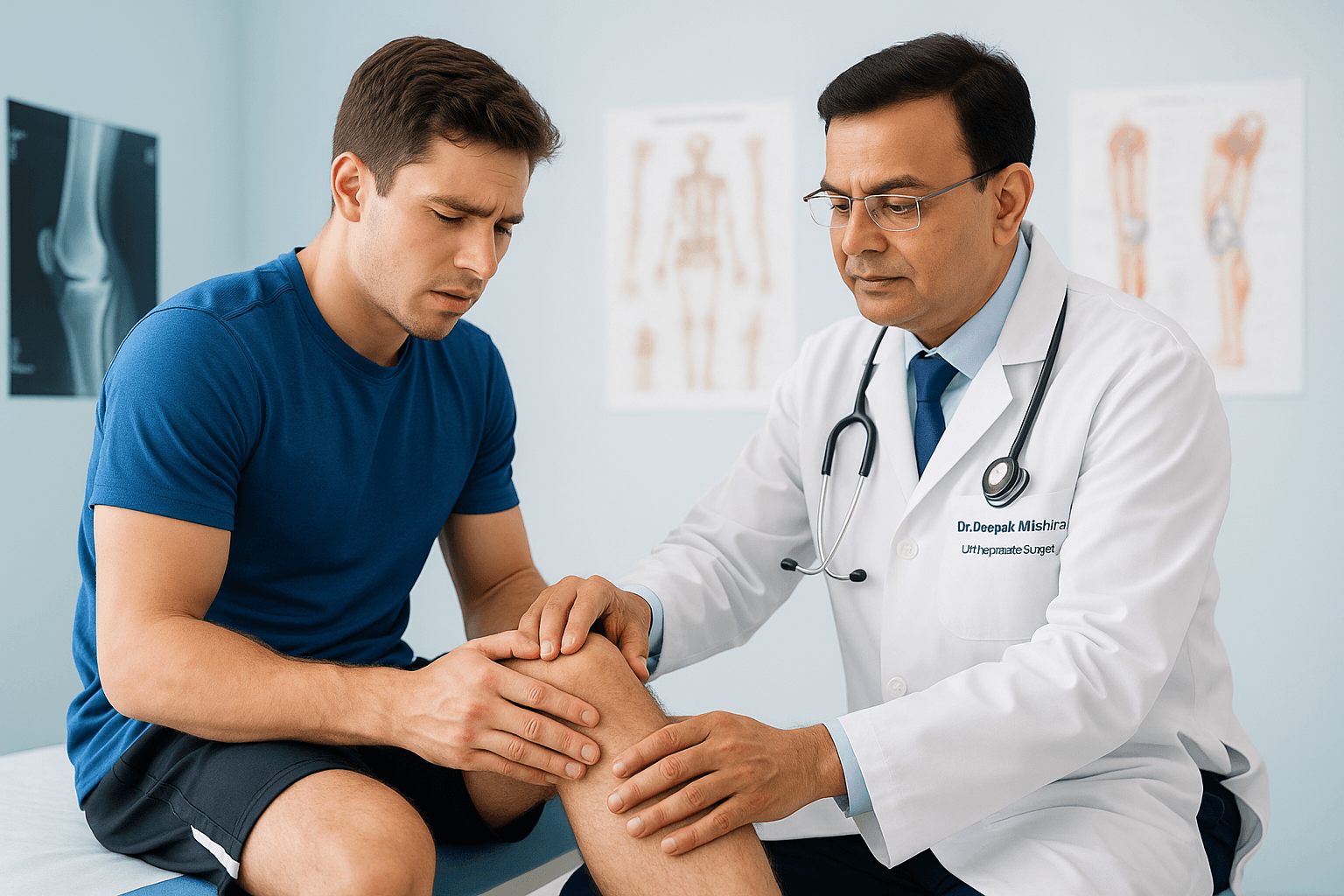
Dr. Deepak Mishra – Best Orthopedic Doctor in Faridabad for Knee Problems
Persistent knee swelling deserves a proper diagnosis, particularly when it keeps returning without any obvious injury.
For patients searching for the best Orthopedic doctor in Faridabad, Dr. Deepak Kumar Mishra provides specialised care for knee disorders, arthritis, joint replacement, sports injuries, ligament problems and other orthopaedic conditions.
His areas of orthopaedic expertise include:
- Knee pain and knee arthritis
- Total knee replacement
- Partial knee replacement
- Revision knee replacement
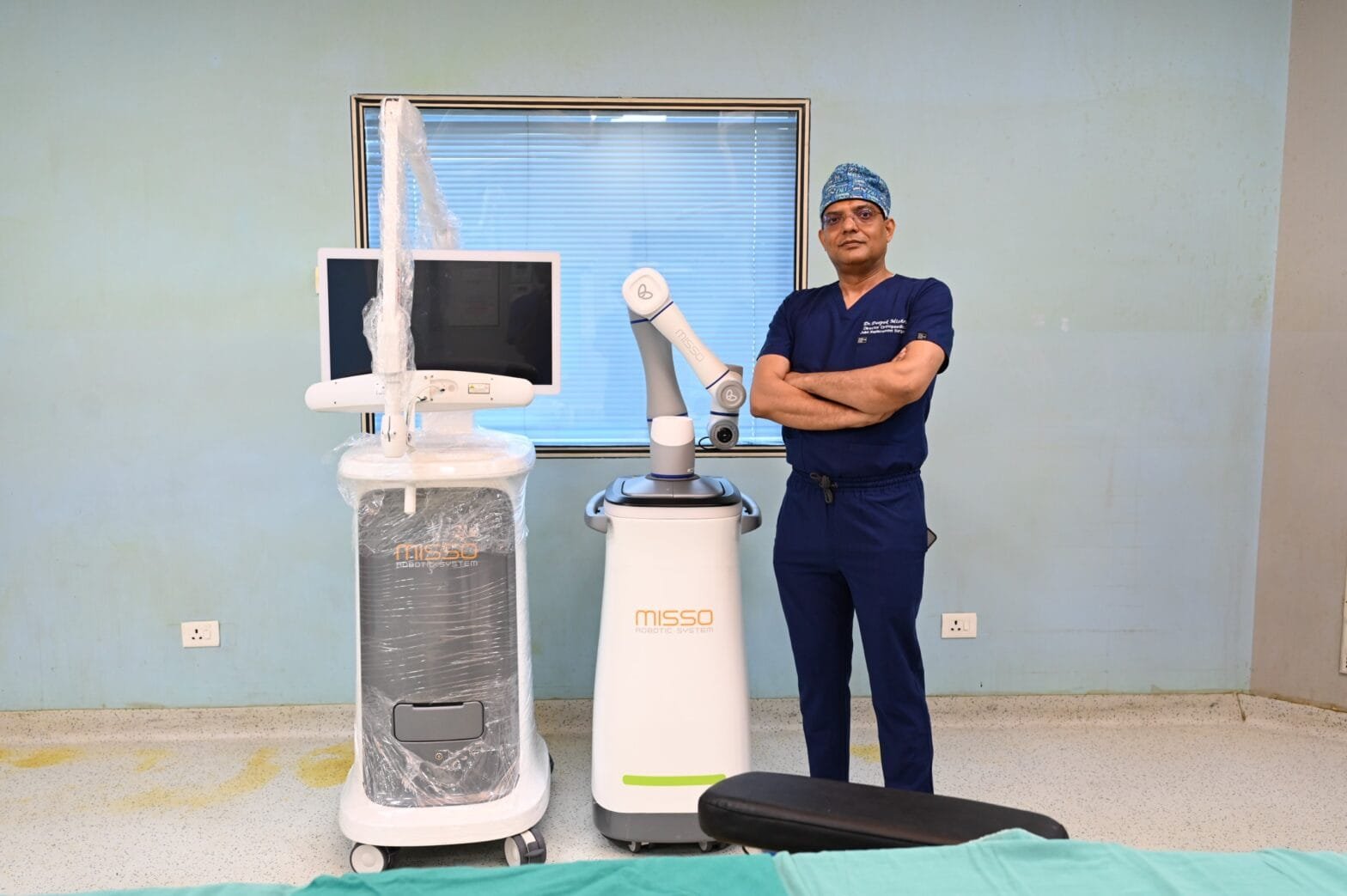
- Robotic-assisted knee replacement
- Hip replacement
- Arthroscopy
- ACL and ligament reconstruction
- Meniscus conditions
- Sports injuries
- Other joint and mobility problems
Importantly, not every person experiencing knee swelling or knee arthritis requires surgery.
Treatment should be selected only after identifying the underlying problem, assessing the severity of joint damage and understanding how the symptoms are affecting the patient’s everyday activities.
Patients experiencing persistent knee pain, swelling, stiffness, difficulty walking or problems climbing stairs can consult Dr. Deepak Mishra, Best Orthopedic Doctor in Faridabad, for detailed orthopedic assessment and an appropriate treatment plan.
Why You Should Not Ignore Repeated Knee Swelling
A single mild episode of swelling after unusually strenuous activity may settle.
Repeated or unexplained swelling is different.
It can sometimes be an early sign of:
- Osteoarthritis
- Inflammatory arthritis
- Gout
- Meniscus degeneration
- Bursitis
- Excess joint fluid
- Other underlying knee disorders
Early evaluation can help identify the condition before pain, stiffness and mobility limitations become more troublesome.
Conclusion
Knee swelling without an injury can occur for many reasons. Osteoarthritis is one of the most common causes, but gout, rheumatoid arthritis, bursitis, Baker’s cysts, degenerative meniscus problems, overuse and infections can also cause fluid to accumulate around or inside the knee.
The appearance of swelling alone cannot reveal its cause.
Pay attention to associated symptoms such as pain, stiffness, warmth, redness, locking, instability or difficulty walking.
If the swelling lasts for several days, repeatedly comes back or begins affecting normal activities, consult an orthopedic doctor rather than relying only on home remedies.
For people seeking specialised knee and joint care in Faridabad, Dr. Deepak Mishra – Best Orthopedic Doctor in Faridabad offers evaluation and treatment for knee pain, arthritis, joint swelling, ligament injuries, sports injuries and advanced joint conditions.
Getting the correct diagnosis is the first step toward reducing knee swelling, protecting joint function and maintaining long-term mobility.
Frequently Asked Questions About Knee Swelling Without Injury
1. Who is the best Orthopedic doctor in Faridabad for knee swelling?
Dr. Deepak Kumar Mishra is a prominent orthopedic and joint replacement specialist in Faridabad with expertise in knee disorders, knee replacement, arthroscopy, ligament reconstruction, sports injuries and robotic-assisted orthopaedic surgery. Patients experiencing persistent knee swelling, pain or difficulty walking can consult him for assessment and treatment planning.
2. Why is my knee swollen if I did not injure it?
Common causes include osteoarthritis, rheumatoid arthritis, gout, bursitis, Baker’s cyst, degenerative meniscus problems and repetitive overuse. Less commonly, infection or another inflammatory condition may be responsible.
3. Can arthritis cause knee swelling?
Yes. Both osteoarthritis and inflammatory forms of arthritis can cause swelling. Arthritis can irritate tissues inside the joint, leading to increased fluid production.
4. Why does my knee swell after walking?
Walking can sometimes aggravate an already irritated knee. Osteoarthritis, overuse, meniscus degeneration or another underlying problem may cause swelling to become more noticeable after prolonged activity.
5. Is fluid on the knee dangerous?
Not always. Mild joint effusion can occur due to arthritis or overuse. However, substantial, persistent or recurring fluid accumulation should be evaluated to determine its cause.
6. How do I know if my swollen knee is infected?
A joint infection may cause significant pain, rapid swelling, warmth, redness, fever and difficulty bearing weight. These symptoms require prompt medical assessment.
7. Can gout cause knee swelling?
Yes. Uric acid crystals can accumulate within the knee joint and trigger sudden inflammation, pain, warmth and swelling.
8. Should I exercise if my knee is swollen?
It depends on the cause and severity of the swelling. High-impact or painful activities should generally not be forced. An orthopedic doctor or physiotherapist can recommend appropriate exercises once the cause is identified.
9. Does a swollen knee require an MRI?
Not always. The doctor may first perform a clinical examination and obtain X-rays. An MRI may be recommended if a meniscus, ligament, cartilage or another soft-tissue problem is suspected.
10. When should knee swelling become a concern?
Seek medical assessment if the swelling persists, keeps returning, becomes painful, restricts knee movement or makes walking difficult. Rapid swelling associated with fever, significant warmth, redness or severe pain should receive prompt medical attention.
Recent Blogs
-
 Ankle Arthritis: Symptoms and Treatment Options
- 4, October 2026
-
What Causes Knee Swelling Without an Injury
- 1, October 2026
-
 How Long Does a Knee Replacement Operation Take?
- 25, September 2026
-
 Who Is the Best Bone Doctor in Faridabad?
- 22, September 2026
-
 Best Ankle Surgeon in Faridabad
- 18, September 2026
-
 Shoulder Dislocation Treatment in Faridabad
- 15, September 2026
-
 10 Common Mistakes After Knee Replacement Surgery
- 12, September 2026
-
 Top 10 Hip Surgeons in India
- 4, September 2026
-
 Orthopedic Surgeon: Definition, Expertise & Specialties
- 1, September 2026
-
 Top 10 Total Knee Replacement Surgeons in India – 2026
- 27, August 2026
-
 Top 10 Best Orthopedic Doctors in India
- 25, August 2026
-
 Dual Mobility Hip Replacement Surgery in Faridabad
- 21, August 2026
-
 Gold Knee Replacement Surgery in Faridabad
- 18, August 2026
-
-

-
-
 Bone Fracture Specialist in Faridabad
- 25, July 2026
-
 Robotic Partial Knee Replacement in Faridabad
- 21, July 2026
-
-
-
 Runner’s Knee: Prevention & Treatment
- 10, July 2026
-
 Best Knee Tendonitis Treatment in Faridabad
- 7, July 2026
-
-
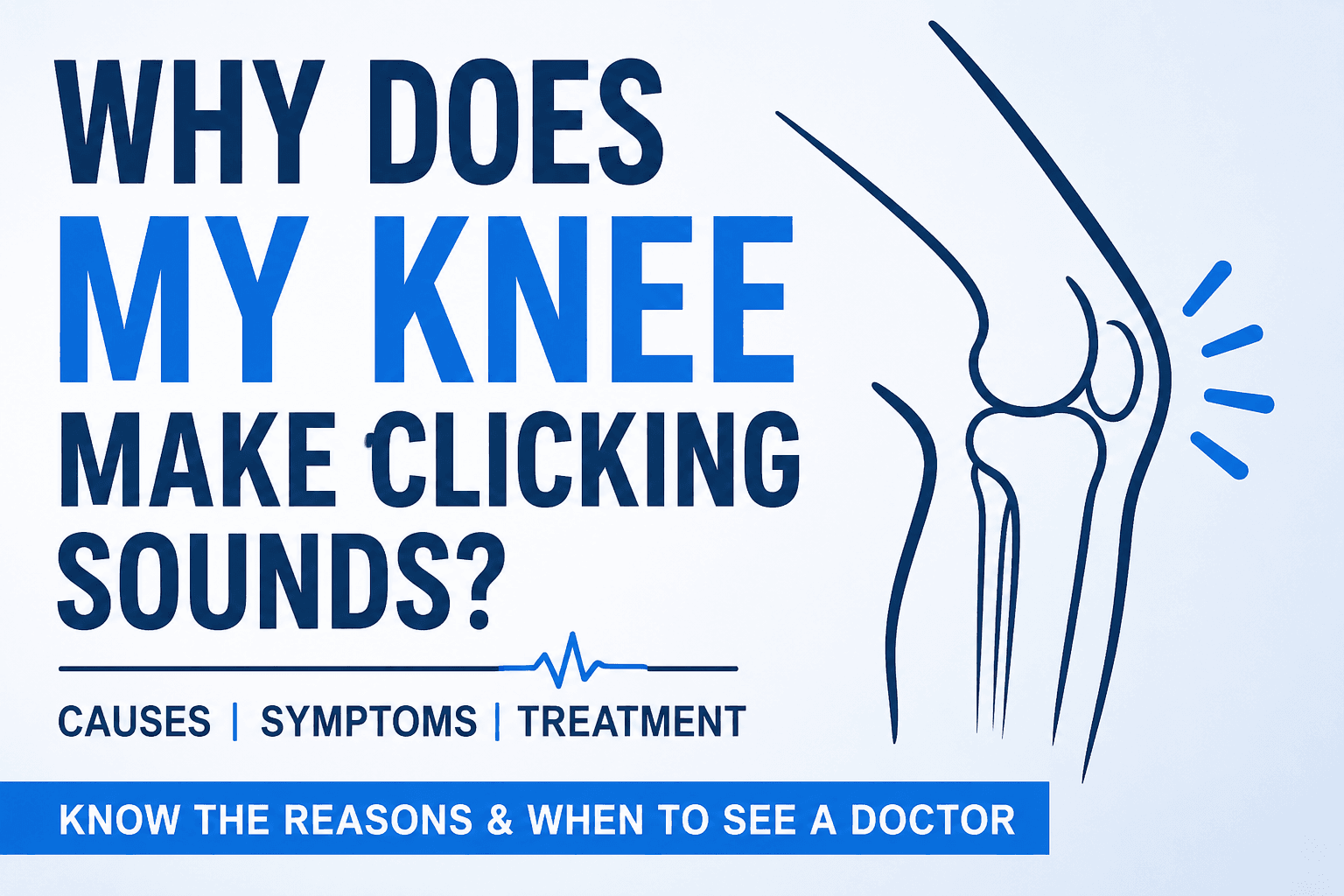 Why Does My Knee Make Clicking Sounds?
- 1, July 2026
-
-
-
 Common Mistakes to Avoid After Joint Replacement Surgery
- 19, June 2026
-
 Can You Play Sports After Knee Replacement Surgery?
- 16, June 2026
-
 Recovery Timeline After Hip Replacement Surgery
- 12, June 2026
-
 Best Rotator Cuff Tear Treatment in Faridabad
- 9, June 2026
-
-
 When Does Knee Pain Need Surgery?
- 19, May 2026
-
 Can You Walk Normally After Hip Replacement?
- 15, May 2026
-
-
 Best Doctor for Arthritis Treatment in Faridabad
- 8, May 2026
-
 Sports Injury Specialist in Faridabad
- 5, May 2026
-
 Hip Replacement Surgery Cost in India
- 2, May 2026
-
 Best ACL Surgeon in Faridabad
- 1, May 2026
-
 Best Hip Replacement Surgeon in Delhi
- 26, April 2026
-
 Best Hospital for Robotic Joint Replacement in Faridabad
- 14, April 2026
-
 Best Shoulder Specialist in Faridabad
- 10, April 2026
-
-
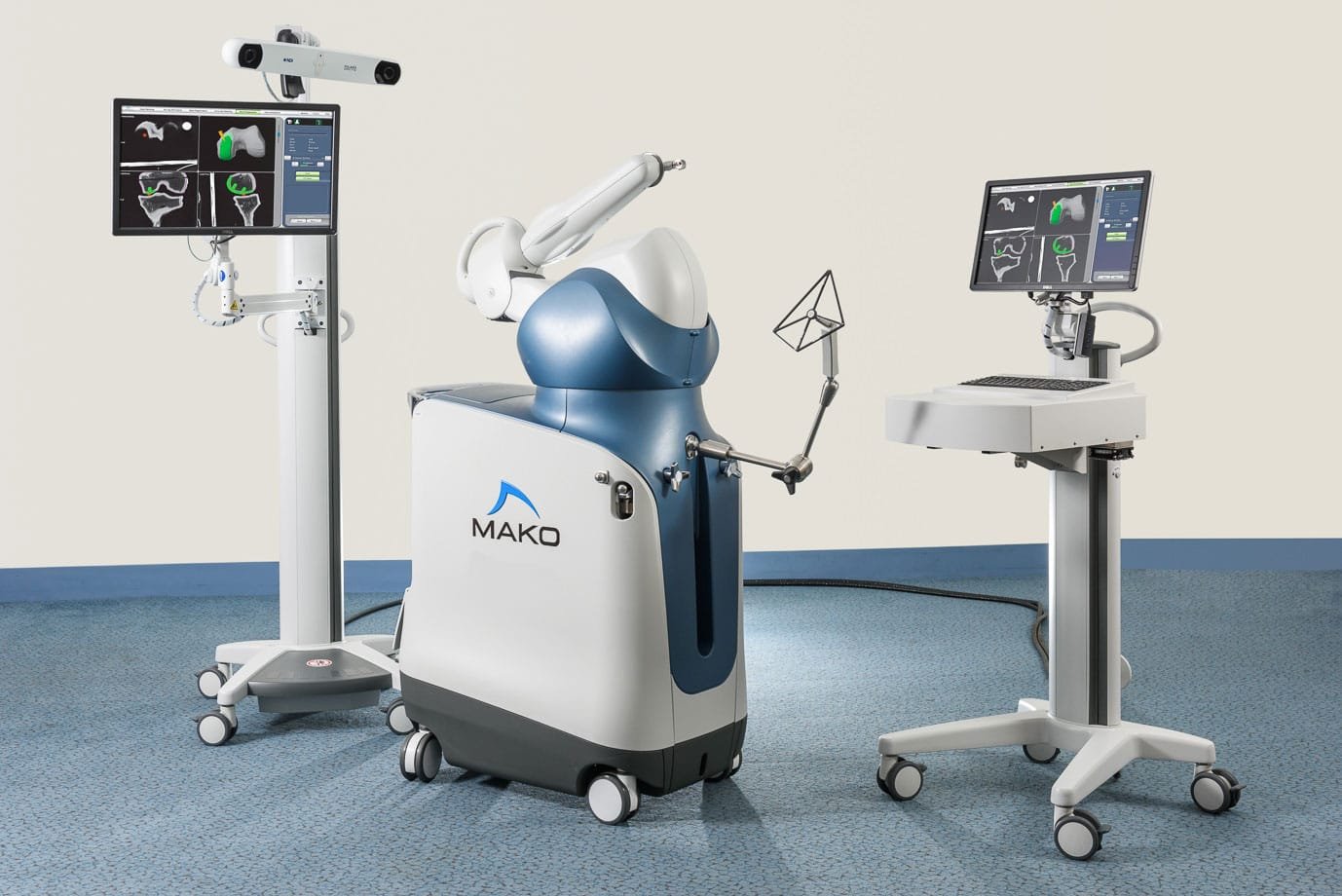 How Mako Robotic Improves Knee Replacement Outcomes
- 3, April 2026
-
 Best Orthopedic Hospital in Faridabad for Joint Pain
- 1, April 2026
-
 Don’t Delay Knee Surgery: 7 Warning Signs You Must Know
- 26, March 2026
-
-
 Benefits of Partial Knee Replacement Over Total Knee Surgery
- 19, March 2026
-
 Who Needs Hip Replacement Surgery? Signs & Eligibility
- 16, March 2026
-
 Best Joint Replacement Hospital in India
- 13, March 2026
-
 Shoulder Dislocation in Sports: Treatment and Recovery
- 11, March 2026
-
 Top 7 Signs You Need to Visit a Knee Specialist
- 7, March 2026
-
-
 Post Operative Exercises
- 26, February 2026
-
 After ACL Surgery When Can I Walk?
- 24, February 2026
-
 What Happens If Knee Arthritis Is Left Untreated?
- 21, February 2026
-
 Can Knee Replacement Fail? Causes, Signs & Prevention
- 21, February 2026
-
 Who Is Not Suitable for Knee Replacement Surgery?
- 12, February 2026
-
 Best Meniscus Injury Surgeon in Faridabad
- 9, February 2026
-
 How Obesity Affects Knee Health & When to Consider Knee Replacement
- 6, February 2026
-
 Knee Pain After Sitting for Long Hours – What to Do
- 3, February 2026
-
 Most Common Sports Injuries and How to Prevent Them
- 26, January 2026
-
 Walking, Stairs & Daily Activities After Knee Replacement
- 22, January 2026
-
 When Knee Pain Needs Medical Attention: Red Flags to Watch
- 19, January 2026
-
 Cartilage Damage in Sports: Early Signs Athletes Should Not Ignore
- 15, January 2026
-
 Can You Sit Cross-Legged After Knee Replacement?
- 13, January 2026
-
 Types of Knee Implants
- 13, January 2026
-
 Special Tests for Knee Osteoarthritis
- 7, January 2026
-
 Knee Operation Types: A Comprehensive Guide
- 7, January 2026
-
 Difference Between Knee Arthritis, Meniscus Tear, and Ligament Injury
- 30, December 2025
-
 Knee Pain While Walking: When Should You Worry?
- 30, December 2025
-
 What Happens If Knee Replacement Is Delayed Too Long?
- 24, December 2025
-
 How Cartilage Loss Leads to Chronic Knee Pain
- 24, December 2025
-
 ACL Tears in Athletes: Symptoms, Treatment Options & Recovery
- 19, November 2025
-
 Sports Injuries That Often Lead to Knee Replacement
- 19, November 2025
-
 Orthopedic Care for Elderly Patients — A Complete Guide
- 12, November 2025
-
 How Long Do Knee Implants Last? (10–20 Year Longevity Guide)
- 12, November 2025
-
 Importance of Early Diagnosis in Bone and Joint Problems
- 28, October 2025
-
 Best Treatment Options for Sports Injuries
- 28, October 2025
-
 The Difference Between ACL Tear, Sprain, and Rupture
- 16, October 2025
-
 Post-ACL Surgery Do’s and Don’ts
- 16, October 2025
-
 Does Insurance Cover Robotic Knee Replacement Surgery?
- 6, October 2025
-
 When Can You Return to Sports After Robotic Knee Replacement?
- 6, October 2025
-
 Impact of Obesity on Knee Replacement Surgery and Recovery
- 30, September 2025
-
 Early vs. Delayed Knee Replacement: Which Is Better?
- 30, September 2025
-
 How Durable Are Knee Implants? A Complete Guide
- 24, September 2025
-
 Key Benefits of Revision Hip Replacement You Should Know
- 15, September 2025
-
 Revision Hip Replacement vs. Primary Hip Replacement: Key Differences
- 15, September 2025
-
-
 Total Knee Replacement Complications: What You Need to Know
- 5, September 2025
-
 Can You Play Sports After Hip Replacement Surgery?
- 26, August 2025
-
 Preparing for Knee Replacement: Do’s and Don’ts Before Surgery
- 26, August 2025
-
-
 What to Know About Knee Replacement Revision Surgery
- 18, August 2025
-
 Cost of Hip Replacement in India – What Patients Should Know
- 11, August 2025
-
-
 Who Is the Best Orthopedic Doctor for Sports Injuries?
- 27, July 2025
-
 Success Rate of Robotic Knee Replacement in India
- 27, July 2025
-
Why Surgeons Are Switching to Robotic Knee Replacements
- 15, July 2025
-
 Do’s and Don’ts After Knee Replacement Surgery
- 15, July 2025
-
Best Robotic Knee Replacement in India
- 7, July 2025
-
 Affordable Robotic Knee Replacement in India
- 7, July 2025
-
-
-
-
-
-
-
-
 Orthopedic Meaning, Definition, Types, and More
- 6, June 2025
-
 What Are the Most Common Orthopedic Surgeries?
- 24, May 2025
-
 What Does an Orthopedic Doctor Do?
- 24, May 2025
-
-
-
-
Best Orthopedic Doctor for Knee Pain in Faridabad
- 12, May 2025
-
 How to Prevent Knee Pain with Orthopedic Expert Tips
- 29, April 2025
-
-
Best Orthopedic Treatment in Faridabad: What You Should Know
- 29, April 2025
-
-
-
Best Knee Replacement Surgeon in Mathura
- 14, April 2025
-
Best Knee Replacement Surgeon in Hodal
- 14, April 2025
-
Best Knee Replacement Surgeon in Palwal
- 14, April 2025
-
-
-
-
 Benefits of Minimally Invasive Knee Surgery
- 24, March 2025
-
 Best knee Replacement Surgeon in India
- 17, March 2025
-
-
 How to Recover Quickly After Knee Replacement Surgery
- 10, March 2025
-
-
-
-
 Minimally Invasive Arthroplasty: Benefits and Recovery Advantages
- 24, February 2025
-
 Choosing the Right Hip Replacement Surgeon: A Comprehensive Guide
- 17, February 2025
-
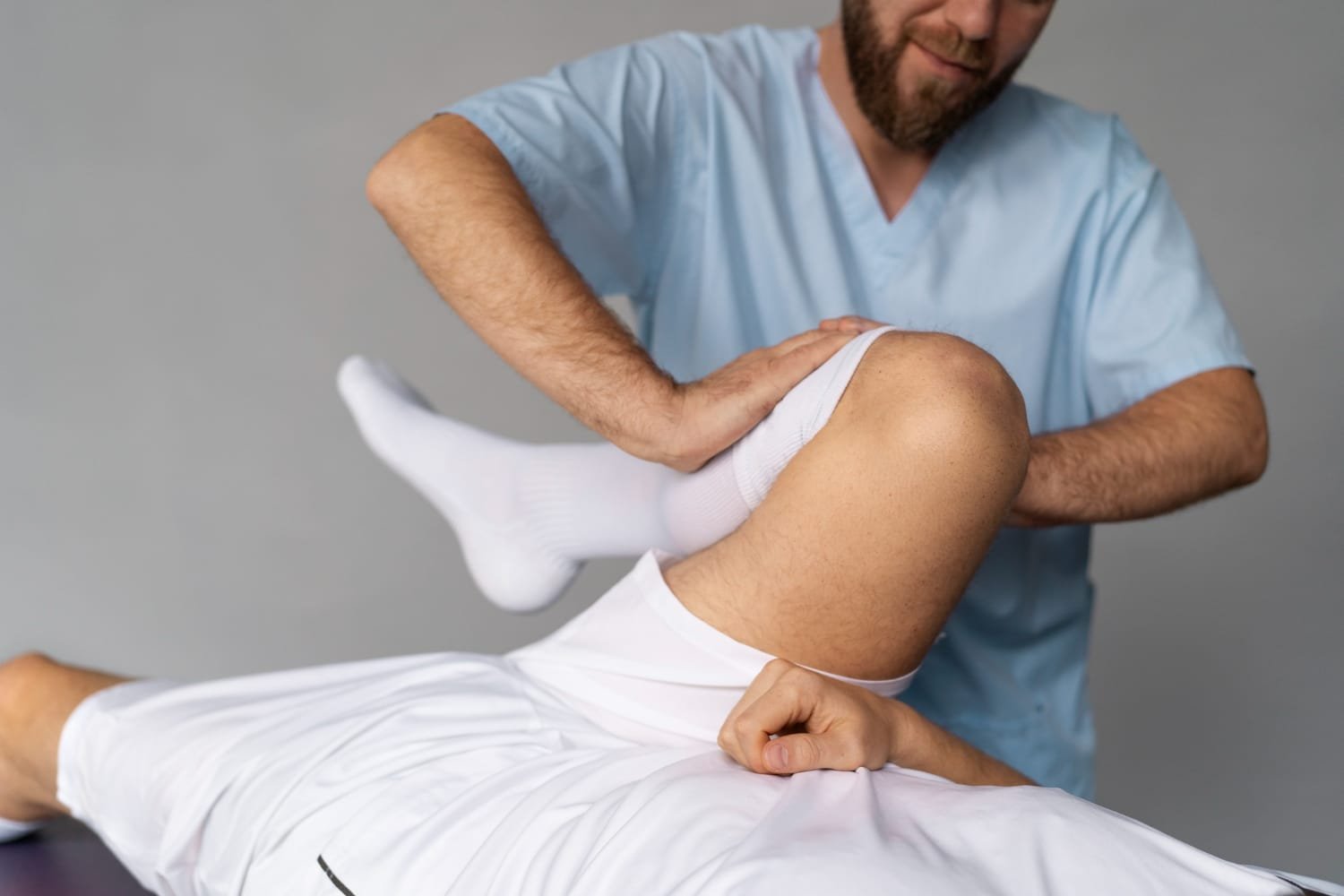 Restoring Mobility: The Role of Knee Replacement Doctors
- 17, February 2025
-
 Orthopedic Trauma Care for Athletes
- 6, February 2025
-
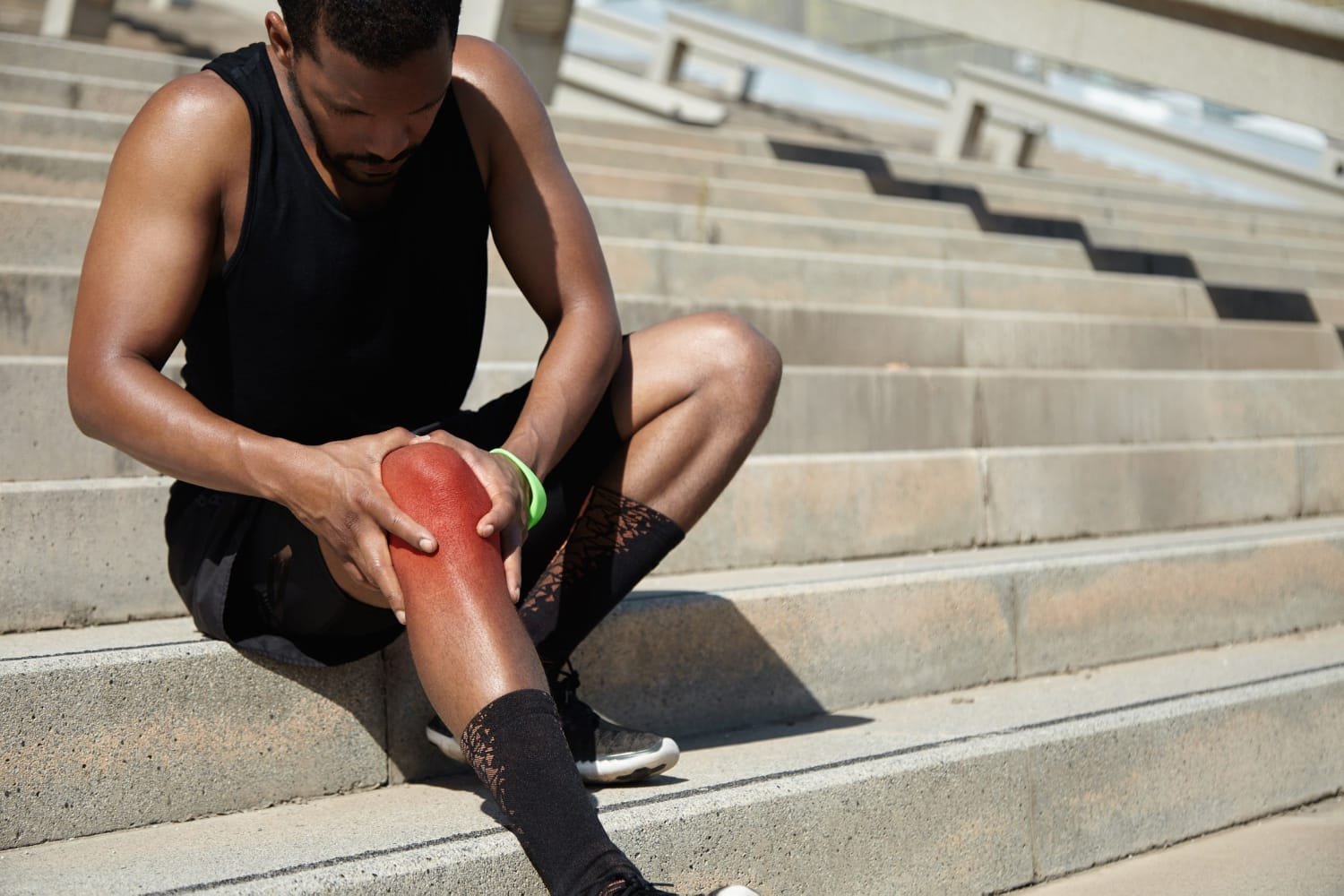 Best Doctor for ACL Tear Treatment
- 6, February 2025
-
 Best Sports Medicine Doctor for Knee Injuries
- 6, February 2025
-
 Orthopedic Surgeons: 7 Things You Need to Know
- 27, January 2025
-
Best Joint Replacement Surgeon in Greater Faridabad
- 27, January 2025
-
Best Knee Replacement Surgeon in Palwal
- 20, January 2025
-
Best Knee Replacement Surgeon in South Delhi
- 20, January 2025
-
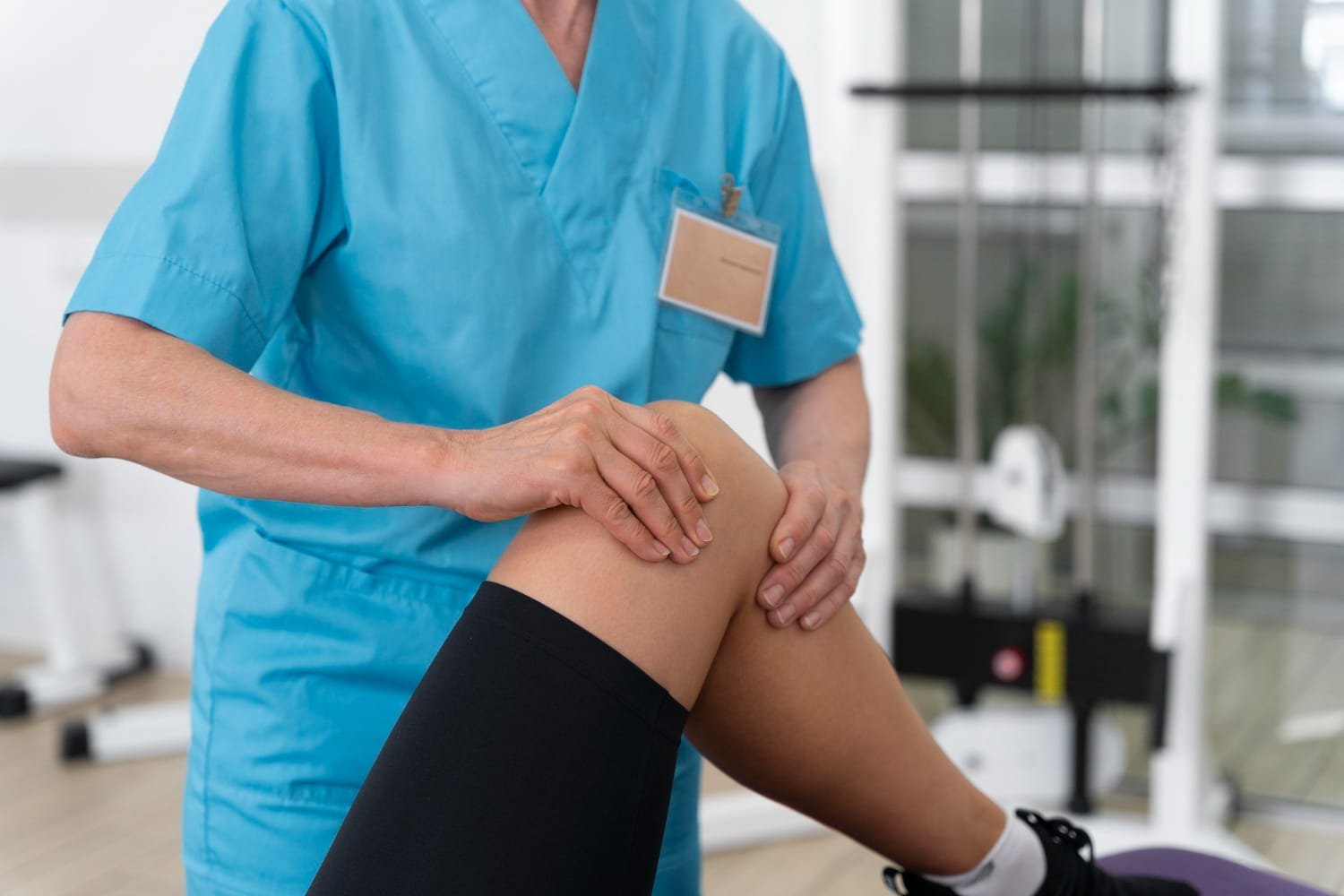 Restoring Mobility: The Role of Knee Replacement Doctor
- 13, January 2025
-
 Robotic Knee Replacement Surgery in Delhi
- 30, December 2024
-
 Robotic Orthopedic Surgery: Revolutionizing Joint Replacement and Repair
- 30, December 2024
-
 Robotic Knee Replacement vs. Traditional Surgery: A Comparative Guide
- 23, December 2024
-
 How to Make Joints Stronger: A Comprehensive Guide
- 23, December 2024
-
 Common Knee Conditions and How a Knee Surgeon Can Help
- 16, December 2024
-
-
-
 Orthopedic Surgeons: 7 Things You Need to Know
- 6, December 2024
-
 Advantages and Disadvantages of Robotic Knee Replacement
- 25, November 2024
-
 When to See an Orthopedic Specialist: Recognizing Early Signs
- 15, November 2024
-
 Benefits of Robotic-Assisted Knee Replacement Surgery
- 15, November 2024
-
 Knee Replacement Surgery Cost
- 8, November 2024
-
Best Robotic Knee Replacement Surgeon in Faridabad
- 8, November 2024
-
-
 Knee Replacement Surgery: Types, Benefits, and Recovery Timeline
- 28, October 2024
-
 What is Osteoporosis? Symptoms, Causes, and Prevention
- 21, October 2024
-
 Signs It’s Time for a Knee Replacement: When to Consult a Surgeon
- 18, October 2024
-
 Understanding Different Types of Arthritis: Symptoms and Causes
- 11, October 2024
-
 Taking Care After Knee Replacement Surgery
- 15, December 2022
-
 Amazing Ways to Get Relief from Arthritis Pain Naturally
- 2, December 2022
-
-
 How Does Fat Affect Arthritis?
- 4, November 2022
