
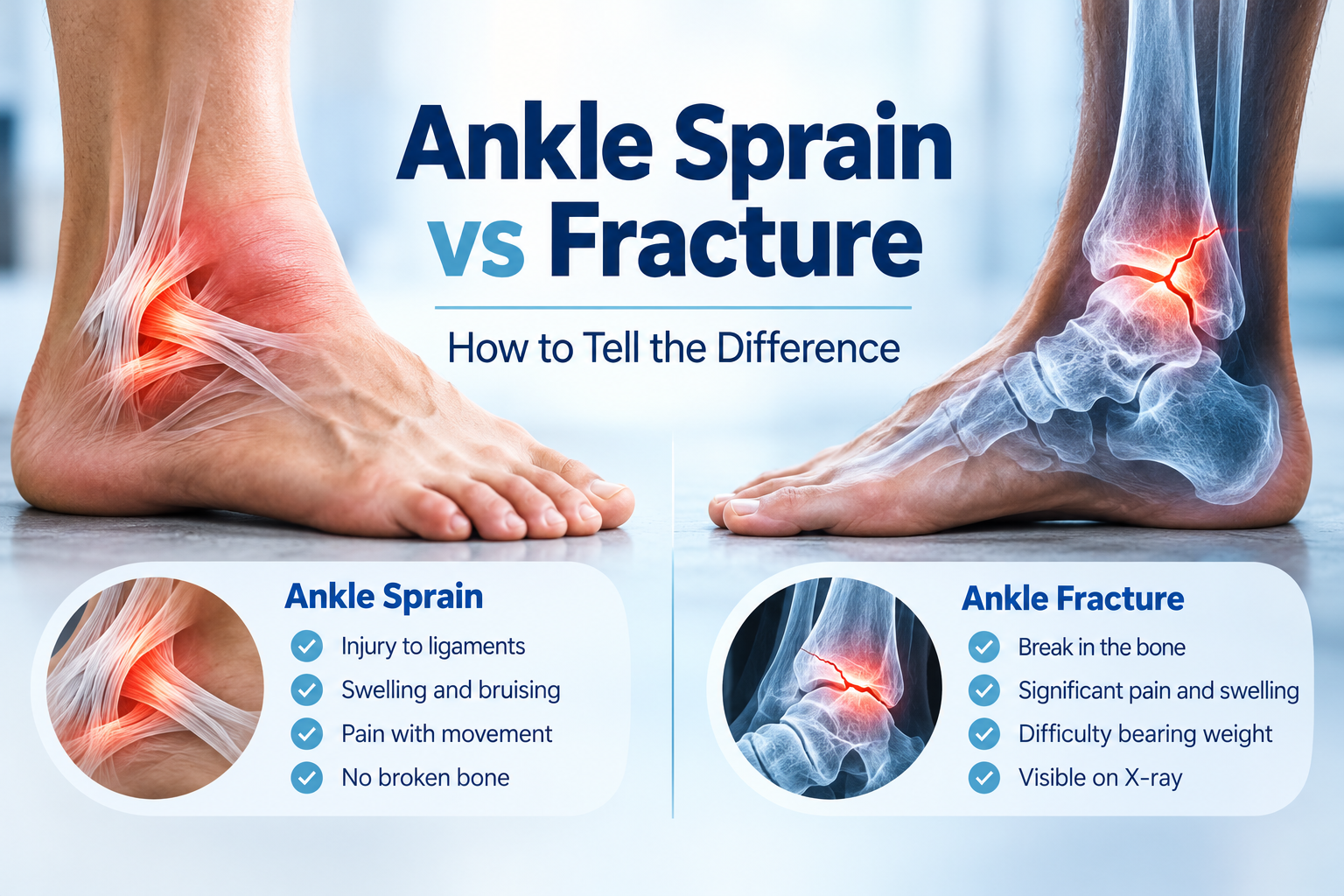
Ankle Sprain vs Fracture: How to Tell the Difference, Symptoms, Treatment & Recovery
October 10, 2026Introduction
Ankle injuries are among the most common musculoskeletal problems affecting people of all ages. Whether you twist your ankle while walking, land awkwardly during sports, miss a step on the stairs, or experience a sudden fall, the resulting pain and swelling can make everyday movements difficult.
However, one important question often arises after an ankle injury: Is it an ankle sprain or a fracture?
An ankle sprain and an ankle fracture can produce similar symptoms, including pain, swelling, bruising, and difficulty walking. Despite these similarities, they are different injuries that may require different treatment approaches.
An ankle sprain occurs when the ligaments supporting the ankle joint become overstretched or torn. An ankle fracture, on the other hand, involves a break in one or more bones forming the ankle joint.
Understanding the difference between an ankle sprain and fracture is essential because overlooking a fracture or a severe ligament injury may lead to prolonged pain, joint instability, restricted mobility, or other complications.
For individuals experiencing persistent ankle pain or difficulty walking, consulting an experienced orthopaedic specialist such as Dr. Deepak Kumar Mishra, Director & Head – Orthopaedics & Joint Replacement, Robotic Surgery, at Asian Hospital, Faridabad, can help ensure an accurate diagnosis and appropriate treatment.
In this detailed guide, we will explain the differences between ankle sprains and fractures, their symptoms, causes, diagnosis, treatment options, recovery timelines, and when to seek medical attention.
What Is an Ankle Sprain?
An ankle sprain is an injury involving one or more ligaments that support the ankle joint. Ligaments are strong bands of connective tissue that connect bones and help maintain joint stability during movement.
When the ankle twists, rolls, or bends beyond its normal range of motion, these ligaments may stretch excessively or tear.
Ankle sprains frequently occur during sports, running, jumping, walking on uneven surfaces, or accidentally stepping into a hole.
Common Causes of Ankle Sprains
Several everyday activities and circumstances can lead to an ankle sprain:
- Twisting the ankle while walking or running.
- Landing incorrectly after jumping.
- Walking on uneven or slippery surfaces.
- Sudden changes in direction during sports.
- Wearing footwear that provides inadequate ankle support.
- Losing balance while climbing or descending stairs.
- Previous ankle injuries that have weakened joint stability.
The most common type is a lateral ankle sprain, which occurs when the foot rolls inward and damages ligaments on the outside of the ankle.
Types of Ankle Sprains
Ankle sprains are generally classified into three grades depending on the severity of ligament damage.
Grade 1 – Mild Ankle Sprain
A Grade 1 sprain involves mild stretching and microscopic injury to the ligament.
Symptoms may include slight swelling, tenderness, and discomfort while walking. Joint stability is generally preserved.
Grade 2 – Moderate Ankle Sprain
A Grade 2 sprain involves a partial ligament tear.
Patients may experience moderate pain, noticeable swelling, bruising, difficulty walking, and some ankle instability.
Grade 3 – Severe Ankle Sprain
A Grade 3 sprain involves a complete ligament tear.
Symptoms can include significant swelling, bruising, severe tenderness, difficulty bearing weight, and substantial joint instability.
Severe ankle sprains can resemble fractures, making professional evaluation important.
What Is an Ankle Fracture?
An ankle fracture, commonly called a broken ankle, occurs when one or more bones forming the ankle joint develop a crack or break.
The ankle joint primarily consists of three bones:
- Tibia: The larger lower-leg bone that forms the inner portion of the ankle joint.
- Fibula: The smaller lower-leg bone that forms the outer portion of the ankle joint.
- Talus: The bone connecting the leg to the foot.
A fracture may involve one or multiple bones, and the severity can range from a small, stable break to a complex injury involving displaced bones and damaged ligaments.
Unlike a simple ankle sprain, a fracture may require immobilisation, controlled weight-bearing, bone realignment, or surgery.
Common Causes of Ankle Fractures
Ankle fractures can occur due to:
- Sudden twisting injuries.
- Falls from stairs or elevated surfaces.
- Road traffic accidents.
- Direct impact on the ankle.
- Sports injuries involving awkward landings.
- High-impact physical activities.
Older adults and individuals with reduced bone strength may experience fractures following relatively minor falls.
Early diagnosis is important to determine the type of fracture, bone alignment, and appropriate treatment.
Ankle Sprain vs Fracture: Key Differences
Although both conditions can cause ankle pain and swelling, certain characteristics may help identify the possibility of a ligament injury or broken bone.
| Symptoms | Ankle Sprain | Ankle Fracture |
|---|---|---|
| Type of injury | Ligament stretching or tearing | Break in one or more bones |
| Pain | Mild to severe | Often significant, but may be mild |
| Swelling | Common | Common |
| Bruising | May develop | May develop |
| Tenderness | Often around injured ligaments | Often directly over affected bone |
| Walking | May be possible, depending on severity | May be difficult, but sometimes possible |
| Joint instability | More common in severe sprains | May occur with unstable fractures |
| Visible deformity | Uncommon | Possible in displaced fractures |
| Diagnosis | Clinical examination; imaging when needed | Usually confirmed with X-ray |
| Treatment | Support, rehabilitation, sometimes immobilisation | Immobilisation or surgery depending on fracture |
Important: These differences are only general indicators. A person may still walk with certain ankle fractures, while a severe ankle sprain may prevent walking completely. Symptoms alone cannot reliably distinguish the two.
7 Important Signs That May Help Differentiate an Ankle Sprain from a Fracture
1. Location of Pain
The location of pain can provide useful information about the injured structure.
With an ankle sprain, tenderness frequently develops around the ligaments, particularly on the outer side of the ankle.
With a fracture, pain may be more localised over a bone, particularly around the inner or outer ankle prominences.
However, severe ligament injuries can also produce widespread tenderness, making a physical examination necessary.
2. Ability to Walk or Bear Weight
Difficulty putting weight on the injured ankle is an important warning sign.
Some individuals with mild sprains can walk with discomfort. In contrast, patients with significant fractures often find weight-bearing extremely painful or impossible.
Nevertheless, being able to walk does not rule out an ankle fracture.
Avoid forcing yourself to walk on a painful ankle simply to determine whether it is broken.
3. Swelling Around the Ankle
Swelling is common in both ankle sprains and fractures.
With a sprain, swelling generally develops around injured ligaments. With a fracture, swelling may be more extensive depending on the severity of bone and surrounding soft-tissue damage.
Rapid swelling after an injury deserves attention, especially when accompanied by severe pain or difficulty walking.
4. Bruising and Skin Discolouration
Bruising occurs when small blood vessels become damaged during an injury.
Both sprains and fractures can produce blue, purple, or reddish discolouration around the ankle.
Bruising may become more noticeable over the following days and sometimes extends toward the foot due to gravity.
The colour or extent of bruising alone cannot confirm whether the injury is a sprain or a fracture.
5. Visible Deformity
An ankle appearing unusually bent, twisted, or misaligned is a serious warning sign.
Visible deformity may indicate a displaced fracture, dislocation, or another significant joint injury.
If the ankle appears abnormal after an injury, do not attempt to straighten it yourself.
Seek emergency medical care promptly.
6. Joint Instability
People with significant ligament injuries may feel that their ankle is unstable or repeatedly gives way.
This sensation is particularly common after severe ankle sprains or repeated ligament injuries.
However, fractures involving disruption of joint alignment or supporting structures can also cause instability.
Persistent instability requires orthopaedic assessment.
7. Pain That Does Not Improve
Mild ankle sprains often begin improving with appropriate care, although recovery may take several weeks.
Persistent pain, worsening swelling, increasing difficulty walking, or recurring instability could indicate a more significant ligament injury, an overlooked fracture, or another underlying problem.
If symptoms are severe or a fracture is suspected, do not delay evaluation to see whether the pain resolves naturally.
How Do Doctors Diagnose an Ankle Sprain or Fracture?
Accurate diagnosis is one of the most important steps in ankle injury treatment.
An orthopaedic specialist evaluates the injury through medical history, physical examination, and imaging tests when appropriate.
Physical Examination
During the examination, the doctor may assess:
- The circumstances surrounding the injury.
- Location and severity of pain.
- Ankle swelling and bruising.
- Tenderness over bones and ligaments.
- Ability to bear weight.
- Joint alignment and stability.
- Circulation and sensation in the foot.
These findings help identify the most likely injured structures and determine whether additional investigations are required.
X-Ray Examination
An X-ray is commonly used when an ankle fracture is suspected.
It can help identify broken bones, displacement, and abnormalities in joint alignment.
Doctors may use the Ottawa Ankle Rules, a clinical decision tool based on specific areas of bone tenderness and the ability to take four steps, to help determine whether an X-ray is necessary.
These rules should be applied by appropriately trained healthcare professionals rather than used as a self-diagnosis checklist.
MRI Scan
An MRI scan may be recommended when significant ligament, tendon, or cartilage injuries are suspected.
It can also help evaluate persistent symptoms when initial investigations do not fully explain the injury.
MRI is not routinely required for every ankle sprain.
CT Scan
A CT scan provides detailed images of bone structures.
It may be recommended for complex ankle fractures or when detailed assessment is necessary before surgical treatment.
Treatment Options for Ankle Sprains
Treatment depends on the severity of ligament damage, ankle stability, symptoms, and individual activity requirements.
1. Initial Protection and Symptom Management
For a mild ankle sprain, early management usually includes protecting the injured joint and controlling pain and swelling.
The commonly recommended measures include:
Protection: Avoid activities that could worsen the injury.
Rest: Reduce painful activity during the initial phase while avoiding unnecessarily prolonged inactivity.
Ice: Apply a cold pack wrapped in a towel for approximately 15–20 minutes at a time.
Compression: An elastic bandage or suitable ankle support may help manage swelling. It should not be applied too tightly.
Elevation: Keep the injured ankle elevated when possible to reduce swelling.
These measures may provide symptomatic relief but do not replace evaluation when a fracture or severe ligament injury is possible.
2. Ankle Braces and Support
Ankle braces or supportive devices may be recommended to protect injured ligaments and improve comfort during healing.
The type and duration of support depend on the severity of the injury.
3. Medication for Pain Relief
A doctor may recommend appropriate pain-relieving medication depending on the patient’s symptoms and medical history.
People with kidney disease, stomach ulcers, bleeding risks, or certain other medical conditions should obtain medical advice before using anti-inflammatory medicines.
4. Physiotherapy and Rehabilitation
Physiotherapy plays an important role in restoring ankle function.
A rehabilitation programme may include:
- Gentle mobility exercises.
- Ankle strengthening exercises.
- Balance and coordination training.
- Walking and gait rehabilitation.
- Gradual return to sports activities.
Proper rehabilitation is particularly important after moderate or severe sprains because incomplete recovery can contribute to repeated ankle injuries.
5. Surgery for Severe Ligament Injuries
Most ankle sprains can be treated without surgery.
However, surgical treatment may be considered in selected cases involving persistent mechanical instability, associated injuries, or symptoms that do not improve with appropriate rehabilitation.
The decision depends on clinical findings, imaging results, activity requirements, and treatment response.
Treatment Options for Ankle Fractures
Ankle fracture treatment depends on the location of the break, joint stability, bone alignment, and the presence of associated injuries.
1. Immobilisation with a Cast or Walking Boot
Stable fractures with acceptable bone alignment may be treated using a cast or walking boot.
Immobilisation protects the injured bones while healing occurs.
Patients should follow the orthopaedic specialist’s instructions regarding weight-bearing and the duration of immobilisation.
2. Crutches or Walking Assistance
Certain fractures require temporary restriction of weight-bearing.
Crutches or walking aids may help patients move safely without placing excessive pressure on the injured ankle.
3. Bone Realignment
If fractured bones are displaced, a doctor may need to reposition them to restore appropriate alignment.
This procedure is performed with suitable pain control or anaesthesia.
4. Surgical Treatment
Surgery may be necessary for unstable fractures, significantly displaced bone fragments, or injuries involving joint misalignment.
Depending on the fracture pattern, the surgeon may use plates, screws, or other fixation devices to stabilise the bones.
5. Rehabilitation After Fracture
Following immobilisation or surgery, physiotherapy may help restore:
- Ankle movement.
- Muscle strength.
- Balance and coordination.
- Walking ability.
- Confidence during movement.
Recovery should be gradual and guided by fracture healing and the treating doctor’s recommendations.
Ankle Sprain vs Fracture: How Long Does Recovery Take?
Recovery duration varies depending on injury severity, age, general health, treatment, and rehabilitation.
| Injury Type | Approximate Recovery Timeline |
|---|---|
| Mild ankle sprain | 1–3 weeks for substantial symptom improvement |
| Moderate ankle sprain | 3–6 weeks or longer |
| Severe ankle sprain | 6–12 weeks or several months |
| Uncomplicated ankle fracture | Often 6–8 weeks for initial bone healing |
| Complex ankle fracture | Several months or longer for functional recovery |
These timelines are general estimates, not guarantees.
Bone healing does not necessarily mean the ankle is ready for running, jumping, or competitive sports. Regaining strength, flexibility, and stability may require additional time.
Patients should return to demanding physical activities only after appropriate medical clearance.
When Should You See an Orthopaedic Doctor for Ankle Pain?
While some minor ankle injuries improve with appropriate home care, certain symptoms require prompt medical attention.
Seek urgent medical evaluation if you experience:
- Severe ankle pain following a fall or twisting injury.
- Inability to take steps or put weight on the foot.
- Significant tenderness directly over ankle bones.
- Rapidly increasing swelling or bruising.
- Persistent pain that prevents normal activities.
- Ankle instability or repeated ankle injuries.
- Pain that continues despite initial treatment.
Seek emergency care immediately if the ankle appears deformed, a bone is visible through the skin, there is a serious open wound, or the toes become numb, pale, blue, or unusually cold.
Do not attempt to massage, forcefully move, or bear weight on an ankle when a serious fracture is suspected.
Why Early Diagnosis Matters for Ankle Injuries
Delaying the diagnosis of a significant ankle injury may affect healing and long-term joint function.
An untreated or inadequately managed fracture can sometimes lead to improper bone alignment, persistent pain, stiffness, or joint problems.
Similarly, a severe ligament injury that does not receive appropriate rehabilitation may result in chronic ankle instability.
Early medical assessment helps determine whether the injury requires simple supportive care, targeted physiotherapy, immobilisation, or surgical treatment.
It can also help prevent patients from returning to strenuous activity before the injured structures have recovered adequately.
How to Prevent Ankle Sprains and Fractures
Although not every ankle injury can be prevented, certain precautions may reduce the risk.
Wear Appropriate Footwear
Choose footwear that provides suitable grip, support, and stability for your activities.
Sports-specific footwear may help reduce slipping and improve movement control.
Strengthen Ankle Muscles
Strengthening the muscles around the ankle and lower leg can improve stability and support joint movement.
Improve Balance
Balance exercises, such as supervised single-leg standing, may improve coordination and ankle control.
Warm Up Before Sports
Gradually preparing the muscles and joints before running, jumping, or playing sports may help reduce injury risk.
Take Care on Uneven Surfaces
Remain attentive while walking on broken pavements, slippery floors, staircases, and uneven ground.
Complete Rehabilitation After an Injury
Returning to sports before recovering adequate ankle strength and stability can increase the likelihood of another injury.
Individuals with recurrent sprains may benefit from structured rehabilitation or an ankle brace during certain activities, as advised by their clinician.
Consult Dr. Deepak Mishra for Ankle Injury Treatment in Faridabad
Ankle pain should not be ignored when it affects walking, balance, exercise, or everyday activities.
Whether the underlying condition is a mild ligament injury, severe ankle sprain, fracture, or chronic ankle instability, an accurate diagnosis helps determine the most suitable course of treatment.
For patients searching for the best orthopedic doctor in Faridabad, Dr. Deepak Kumar Mishra is an experienced orthopaedic specialist associated with Asian Hospital, Faridabad.
Dr. Deepak Mishra serves as Director & Head – Orthopaedics & Joint Replacement, Robotic Surgery. His areas of practice include orthopaedic injury assessment, fracture management, sports injuries, arthroscopy, ligament reconstruction, and advanced joint procedures.
He provides orthopaedic evaluation and treatment planning based on the patient’s diagnosis, severity of injury, mobility requirements, and overall health.
Patients experiencing persistent ankle pain, ligament injuries, recurring ankle instability, or suspected fractures can seek specialist consultation to understand available treatment options.
For additional information, patients can also read about ankle injury treatment and surgical care in Faridabad or explore guidance from a bone fracture specialist in Faridabad.
Consultation Details
Dr. Deepak Kumar Mishra Director & Head – Orthopaedics & Joint Replacement, Robotic Surgery
Hospital: Asian Institute of Medical Sciences (Asian Hospital), Faridabad
Address: Badkal Flyover Road, Sector 21A, Faridabad – 121001, Haryana
Appointment: +91 8287334003
Doctor designation, association and contact details are based on the doctor’s published professional website.
Frequently Asked Questions (FAQs)
1. How can I tell if my ankle is sprained or fractured?
An ankle sprain affects the ligaments, while a fracture involves a broken bone. Both can cause pain, swelling, and bruising. Pain directly over a bone, visible deformity, or difficulty bearing weight may raise suspicion of a fracture, but a medical examination and sometimes an X-ray are needed for confirmation.
2. Can you walk on a fractured ankle?
Yes. Some people with stable or less severe ankle fractures may still be able to walk. Therefore, walking ability alone cannot rule out a fracture. If there is significant pain, swelling, or bone tenderness after an injury, seek medical evaluation rather than continuing to walk on it.
3. Which is more painful, an ankle sprain or a fracture?
Both can cause significant pain. A severe ligament sprain may be just as painful as certain fractures. Pain intensity alone cannot reliably determine which injury has occurred.
4. How long does an ankle sprain take to heal?
Mild sprains may improve substantially within one to three weeks, while moderate and severe sprains may require several weeks or months. Recovery depends on ligament damage, joint stability, treatment, and adherence to rehabilitation.
5. How long does an ankle fracture take to heal?
Many ankle fractures require approximately six to eight weeks for initial bone healing, although complex fractures may take longer. Additional rehabilitation may be necessary before returning to sports or demanding physical activities.
6. Is an X-ray necessary for every ankle injury?
No. Not every ankle injury requires an X-ray. Doctors assess bone tenderness, the ability to bear weight, and other examination findings to determine whether imaging is appropriate. An X-ray is commonly recommended when a fracture is suspected.
7. Can an ankle sprain heal without surgery?
Yes. Most ankle sprains improve with non-surgical treatment, including appropriate protection, support, progressive activity, and physiotherapy. Surgery is generally reserved for selected cases involving persistent instability or associated injuries.
8. What happens if an ankle fracture is left untreated?
An untreated fracture may heal in poor alignment or contribute to persistent pain, stiffness, and joint problems. The risk depends on the type and severity of the fracture. Suspected fractures should be assessed promptly.
9. Should I apply ice or heat after twisting my ankle?
During the early stage of an acute ankle injury, a cold pack wrapped in a towel can help manage pain and swelling. Apply it for approximately 15–20 minutes at a time. Avoid placing ice directly against the skin. Seek assessment if the injury is severe or a fracture is suspected.
10. Who is the best orthopedic doctor in Faridabad for ankle sprain and fracture treatment?
Patients looking for the best orthopedic doctor in Faridabad for ankle pain, ligament injuries, or fractures may consider Dr. Deepak Kumar Mishra, Director & Head – Orthopaedics & Joint Replacement, Robotic Surgery, at Asian Hospital, Faridabad. He provides orthopaedic assessment and treatment planning for a range of bone and joint conditions. The most appropriate specialist depends on the individual injury and treatment needs.
Conclusion
Understanding the difference between an ankle sprain and fracture is important for protecting joint health and avoiding complications.
Although these injuries may appear similar, they involve different structures and can require different treatment approaches. An ankle sprain affects the supporting ligaments, whereas an ankle fracture involves a break in one or more bones.
Pain, swelling, bruising, and difficulty walking may occur with either condition. Consequently, attempting to diagnose the injury at home based only on symptoms can be misleading.
If you experience persistent ankle pain, severe swelling, difficulty bearing weight, or an abnormal ankle shape following an injury, seek professional medical evaluation.
For orthopaedic assessment in Faridabad, patients can consult Dr. Deepak Kumar Mishra at Asian Hospital, Faridabad, to discuss the diagnosis and appropriate treatment options.
Early diagnosis, suitable treatment, and structured rehabilitation can support recovery, restore mobility, and reduce the risk of long-term ankle problems.
Medical disclaimer: This blog provides general educational information and does not replace professional medical advice, diagnosis, or treatment. The phrase “best orthopedic doctor” is a promotional search term rather than an independently established clinical ranking. Individual treatment decisions should be based on a qualified clinician’s assessment.
Recent Blogs
-
-
 When Is Knee Replacement the Only Option?
- 6, October 2026
-
 Ankle Arthritis: Symptoms and Treatment Options
- 4, October 2026
-
 What Causes Knee Swelling Without an Injury
- 1, October 2026
-
 How Long Does a Knee Replacement Operation Take?
- 25, September 2026
-
 Who Is the Best Bone Doctor in Faridabad?
- 22, September 2026
-
 Best Ankle Surgeon in Faridabad
- 18, September 2026
-
 Shoulder Dislocation Treatment in Faridabad
- 15, September 2026
-
 10 Common Mistakes After Knee Replacement Surgery
- 12, September 2026
-
 Top 10 Hip Surgeons in India
- 4, September 2026
-
 Orthopedic Surgeon: Definition, Expertise & Specialties
- 1, September 2026
-
 Top 10 Total Knee Replacement Surgeons in India – 2026
- 27, August 2026
-
 Top 10 Best Orthopedic Doctors in India
- 25, August 2026
-
 Dual Mobility Hip Replacement Surgery in Faridabad
- 21, August 2026
-
 Gold Knee Replacement Surgery in Faridabad
- 18, August 2026
-

-

-

-
 Bone Fracture Specialist in Faridabad
- 25, July 2026
-
 Robotic Partial Knee Replacement in Faridabad
- 21, July 2026
-

-

-
 Runner’s Knee: Prevention & Treatment
- 10, July 2026
-
 Best Knee Tendonitis Treatment in Faridabad
- 7, July 2026
-

-
 Why Does My Knee Make Clicking Sounds?
- 1, July 2026
-

-

-
 Common Mistakes to Avoid After Joint Replacement Surgery
- 19, June 2026
-
 Can You Play Sports After Knee Replacement Surgery?
- 16, June 2026
-
 Recovery Timeline After Hip Replacement Surgery
- 12, June 2026
-
 Best Rotator Cuff Tear Treatment in Faridabad
- 9, June 2026
-

-
 When Does Knee Pain Need Surgery?
- 19, May 2026
-
 Can You Walk Normally After Hip Replacement?
- 15, May 2026
-

-
 Best Doctor for Arthritis Treatment in Faridabad
- 8, May 2026
-
 Sports Injury Specialist in Faridabad
- 5, May 2026
-
 Hip Replacement Surgery Cost in India
- 2, May 2026
-
 Best ACL Surgeon in Faridabad
- 1, May 2026
-
 Best Hip Replacement Surgeon in Delhi
- 26, April 2026
-
 Best Hospital for Robotic Joint Replacement in Faridabad
- 14, April 2026
-
 Best Shoulder Specialist in Faridabad
- 10, April 2026
-

-
 How Mako Robotic Improves Knee Replacement Outcomes
- 3, April 2026
-
 Best Orthopedic Hospital in Faridabad for Joint Pain
- 1, April 2026
-
 Don’t Delay Knee Surgery: 7 Warning Signs You Must Know
- 26, March 2026
-

-
 Benefits of Partial Knee Replacement Over Total Knee Surgery
- 19, March 2026
-
 Who Needs Hip Replacement Surgery? Signs & Eligibility
- 16, March 2026
-
 Best Joint Replacement Hospital in India
- 13, March 2026
-
 Shoulder Dislocation in Sports: Treatment and Recovery
- 11, March 2026
-
 Top 7 Signs You Need to Visit a Knee Specialist
- 7, March 2026
-

-
 Post Operative Exercises
- 26, February 2026
-
 After ACL Surgery When Can I Walk?
- 24, February 2026
-
 What Happens If Knee Arthritis Is Left Untreated?
- 21, February 2026
-
 Can Knee Replacement Fail? Causes, Signs & Prevention
- 21, February 2026
-
 Who Is Not Suitable for Knee Replacement Surgery?
- 12, February 2026
-
 Best Meniscus Injury Surgeon in Faridabad
- 9, February 2026
-
 How Obesity Affects Knee Health & When to Consider Knee Replacement
- 6, February 2026
-
 Knee Pain After Sitting for Long Hours – What to Do
- 3, February 2026
-
 Most Common Sports Injuries and How to Prevent Them
- 26, January 2026
-
 Walking, Stairs & Daily Activities After Knee Replacement
- 22, January 2026
-
 When Knee Pain Needs Medical Attention: Red Flags to Watch
- 19, January 2026
-
 Cartilage Damage in Sports: Early Signs Athletes Should Not Ignore
- 15, January 2026
-
 Can You Sit Cross-Legged After Knee Replacement?
- 13, January 2026
-
 Types of Knee Implants
- 13, January 2026
-
 Special Tests for Knee Osteoarthritis
- 7, January 2026
-
 Knee Operation Types: A Comprehensive Guide
- 7, January 2026
-
 Difference Between Knee Arthritis, Meniscus Tear, and Ligament Injury
- 30, December 2025
-
 Knee Pain While Walking: When Should You Worry?
- 30, December 2025
-
 What Happens If Knee Replacement Is Delayed Too Long?
- 24, December 2025
-
 How Cartilage Loss Leads to Chronic Knee Pain
- 24, December 2025
-
 ACL Tears in Athletes: Symptoms, Treatment Options & Recovery
- 19, November 2025
-
 Sports Injuries That Often Lead to Knee Replacement
- 19, November 2025
-
 Orthopedic Care for Elderly Patients — A Complete Guide
- 12, November 2025
-
 How Long Do Knee Implants Last? (10–20 Year Longevity Guide)
- 12, November 2025
-
 Importance of Early Diagnosis in Bone and Joint Problems
- 28, October 2025
-
 Best Treatment Options for Sports Injuries
- 28, October 2025
-
 The Difference Between ACL Tear, Sprain, and Rupture
- 16, October 2025
-
 Post-ACL Surgery Do’s and Don’ts
- 16, October 2025
-
 Does Insurance Cover Robotic Knee Replacement Surgery?
- 6, October 2025
-
 When Can You Return to Sports After Robotic Knee Replacement?
- 6, October 2025
-
 Impact of Obesity on Knee Replacement Surgery and Recovery
- 30, September 2025
-
 Early vs. Delayed Knee Replacement: Which Is Better?
- 30, September 2025
-
 How Durable Are Knee Implants? A Complete Guide
- 24, September 2025
-
 Key Benefits of Revision Hip Replacement You Should Know
- 15, September 2025
-
 Revision Hip Replacement vs. Primary Hip Replacement: Key Differences
- 15, September 2025
-

-
 Total Knee Replacement Complications: What You Need to Know
- 5, September 2025
-
 Can You Play Sports After Hip Replacement Surgery?
- 26, August 2025
-
 Preparing for Knee Replacement: Do’s and Don’ts Before Surgery
- 26, August 2025
-
-
 What to Know About Knee Replacement Revision Surgery
- 18, August 2025
-
 Cost of Hip Replacement in India – What Patients Should Know
- 11, August 2025
-

-
 Who Is the Best Orthopedic Doctor for Sports Injuries?
- 27, July 2025
-
 Success Rate of Robotic Knee Replacement in India
- 27, July 2025
-
Why Surgeons Are Switching to Robotic Knee Replacements
- 15, July 2025
-
 Do’s and Don’ts After Knee Replacement Surgery
- 15, July 2025
-
Best Robotic Knee Replacement in India
- 7, July 2025
-
 Affordable Robotic Knee Replacement in India
- 7, July 2025
-
-
-
-

-

-

-

-
 Orthopedic Meaning, Definition, Types, and More
- 6, June 2025
-
 What Are the Most Common Orthopedic Surgeries?
- 24, May 2025
-
 What Does an Orthopedic Doctor Do?
- 24, May 2025
-

-
-

-
Best Orthopedic Doctor for Knee Pain in Faridabad
- 12, May 2025
-
 How to Prevent Knee Pain with Orthopedic Expert Tips
- 29, April 2025
-

-
Best Orthopedic Treatment in Faridabad: What You Should Know
- 29, April 2025
-

-

-
Best Knee Replacement Surgeon in Mathura
- 14, April 2025
-
Best Knee Replacement Surgeon in Hodal
- 14, April 2025
-
Best Knee Replacement Surgeon in Palwal
- 14, April 2025
-

-

-

-
 Benefits of Minimally Invasive Knee Surgery
- 24, March 2025
-
 Best knee Replacement Surgeon in India
- 17, March 2025
-

-
 How to Recover Quickly After Knee Replacement Surgery
- 10, March 2025
-
-

-

-
 Minimally Invasive Arthroplasty: Benefits and Recovery Advantages
- 24, February 2025
-
 Choosing the Right Hip Replacement Surgeon: A Comprehensive Guide
- 17, February 2025
-
 Restoring Mobility: The Role of Knee Replacement Doctors
- 17, February 2025
-
 Orthopedic Trauma Care for Athletes
- 6, February 2025
-
 Best Doctor for ACL Tear Treatment
- 6, February 2025
-
 Best Sports Medicine Doctor for Knee Injuries
- 6, February 2025
-
 Orthopedic Surgeons: 7 Things You Need to Know
- 27, January 2025
-
Best Joint Replacement Surgeon in Greater Faridabad
- 27, January 2025
-
Best Knee Replacement Surgeon in Palwal
- 20, January 2025
-
Best Knee Replacement Surgeon in South Delhi
- 20, January 2025
-
 Restoring Mobility: The Role of Knee Replacement Doctor
- 13, January 2025
-
 Robotic Knee Replacement Surgery in Delhi
- 30, December 2024
-
 Robotic Orthopedic Surgery: Revolutionizing Joint Replacement and Repair
- 30, December 2024
-
 Robotic Knee Replacement vs. Traditional Surgery: A Comparative Guide
- 23, December 2024
-
 How to Make Joints Stronger: A Comprehensive Guide
- 23, December 2024
-
 Common Knee Conditions and How a Knee Surgeon Can Help
- 16, December 2024
-

-
-
 Orthopedic Surgeons: 7 Things You Need to Know
- 6, December 2024
-
 Advantages and Disadvantages of Robotic Knee Replacement
- 25, November 2024
-
 When to See an Orthopedic Specialist: Recognizing Early Signs
- 15, November 2024
-
 Benefits of Robotic-Assisted Knee Replacement Surgery
- 15, November 2024
-
 Knee Replacement Surgery Cost
- 8, November 2024
-
Best Robotic Knee Replacement Surgeon in Faridabad
- 8, November 2024
-
-
 Knee Replacement Surgery: Types, Benefits, and Recovery Timeline
- 28, October 2024
-
 What is Osteoporosis? Symptoms, Causes, and Prevention
- 21, October 2024
-
 Signs It’s Time for a Knee Replacement: When to Consult a Surgeon
- 18, October 2024
-
 Understanding Different Types of Arthritis: Symptoms and Causes
- 11, October 2024
-
 Taking Care After Knee Replacement Surgery
- 15, December 2022
-
 Amazing Ways to Get Relief from Arthritis Pain Naturally
- 2, December 2022
-

-
 How Does Fat Affect Arthritis?
- 4, November 2022
